


Best Apps to Learn Chinese Characters and Writing (2026)
By the Laoshi team. Laoshi is our app, and it is one of the six compared below.
Last updated: November 2026. Prices and features checked between 7 and 17 November 2026.
Learning Chinese characters is really two jobs. One is recognising a character when you see it: its meaning, its sound and the words it appears in. The other is writing it from memory, stroke by stroke. Many apps do the first job well and the second not at all, and store pages don't always make the difference clear.
The new HSK makes the split official. The HSK 3.0 syllabus lists 3,088 characters to recognise across all levels, but far fewer to write by hand: 100 by HSK 1–2, 250 by HSK 3, 400 by HSK 4, 550 by HSK 5, 700 by HSK 6 and 1,200 by HSK 7–9. The first official HSK 3.0 exam is on 13 December 2026, and our HSK 3.0 word lists article explains which list is which.
So before you pick an app, ask four questions:
- Does it make you write, and does it check what you wrote? Some apps grade each stroke, some give hints, and some leave the checking to you.
- Does it show stroke order? As an animation, as diagrams, or as a hint for the next stroke.
- Where do the characters come from? An HSK list, your textbook, a course, or your own cards.
- Does it build recognition? Through reading, review cards or both.
Short answer by need:
- Writing characters by hand, with every stroke graded: Skritter
- A free dictionary, with paid flashcards that include handwriting tests: Pleco
- Writing practice on your own textbook or HSK list, plus a beginner course on characters: Laoshi
- A full beginner course with handwriting built in: HelloChinese
- Free, if you build your own writing deck: Anki
- Learning to read characters in real texts: Du Chinese
How we checked
On 23 November 2026 we read each app's official website, its US App Store listing and, where relevant, its pricing page, forum or release notes. We did not run timed tests, and we have not ranked the apps against each other. Where an app does not state something, the table says "not stated" rather than guessing. Prices are US list prices on the day we checked; store prices differ by country, and some apps list several prices for the same plan.
This page is written by the Laoshi team, and Laoshi's section says what it does not do.
Comparison table
| App | Best for | Handwriting practice | Stroke order shown | HSK 3.0 lists (Nov 2026) | Platforms | Offline | Price (US, checked Nov 2026) |
|---|---|---|---|---|---|---|---|
| Skritter | Writing by hand | Yes, each stroke graded as you write | Yes, stroke-by-stroke feedback | Levels 1–3 on the 2021 standard; 2026 lists in progress | Web, iOS, Android | Yes, with Premium | $14.99/mo, $59.99/6 mo, $99.99/yr; 7-day free trial |
| Pleco | Dictionary users | Handwriting fill-in-the-blank tests in the paid flashcards | Animations: 500 characters free, 28,000 with a $4.99 add-on | Premade cards for the 2026 test (v3.2.82) | iOS, Android | Not stated | Dictionary free; Flashcard System $9.99, Basic Bundle $29.99, Professional Bundle $59.99 |
| Laoshi | Your textbook or HSK list | Yes, on any list, with stroke hints; printable worksheets | Yes: next-stroke hint in the app, animation in the free web dictionary | Official exam lists (chinesetest.cn), incl. 7–9; HSK 2.0 too | iOS, Android; free web Classroom and dictionary | Not stated here; pronunciation check needs internet | App Store $12.99/mo, $79.99/yr, $179.99 lifetime; $12.99/mo or $69.99/yr via web checkout |
| HelloChinese | A beginner course | Handwriting practice in lessons | Not stated | "Based on HSK levels"; version not stated | iOS, Android | Downloaded courses | Free download; Premium $11.99/mo, $25.99/3 mo, $69.99/yr |
| Anki | Free DIY decks | You write on paper and grade yourself | Only if the deck includes it | Community decks only | Windows, macOS, Linux, iOS, Android | Yes (AnkiMobile) | Free; iOS app $24.99 once |
| Du Chinese | Reading | Not stated | Not stated | "HSK-aligned content"; version not stated | iOS, Android, web | Yes, with Premium | Free lessons; Premium $14.99/mo, $79.99/6 mo, $119.99/yr |
Skritter: best for writing characters by hand
Skritter is built around handwriting. You write each character on the screen stroke by stroke, and the app grades the strokes as you go; reviews come back on spaced repetition (App Store). The listing mentions 700+ decks, including chapter-by-chapter textbook decks and TOCFL, and says Premium covers web, mobile and offline use.
On HSK, the listing names HSK 3.0 levels 1 to 3, "with more levels added as they are released", and every HSK 2.0 level. Skritter's HSK 3.0 decks were announced in June 2021 and follow the 2021 standard (forum). In its forum, a staff post from 20 October 2026 says lists for the 2026 exam are still "being organized and updated" (forum).
On its website Premium is $14.99 a month, $59.99 for six months or $99.99 a year, each with a 7-day free trial; the App Store listing also shows lower and higher prices for the same periods. Skritter is about writing and recall, and its listing does not mention grammar lessons.
Pleco: a dictionary with writing add-ons
Pleco is a Chinese dictionary app for iOS and Android. The free app includes two dictionaries, CC-CEDICT with over 110,000 entries and Pleco's own PLC dictionary with 125,000 entries (App Store).
The study tools are paid. The Flashcard System is $9.99 on its own or part of the $29.99 Basic Bundle; the $59.99 Professional Bundle adds more. Its study modes include handwriting fill-in-the-blank tests and tone drills, and version 3.2.82 "added vocabulary for the refreshed 2026 HSK 3.0 test" to the premade cards. Stroke order animations are free for 500 characters; the Stroke Order Diagrams add-on ($4.99) covers 28,000. A full-screen Enhanced Handwriting input is another $9.99.
Pleco's pages don't say whether it works offline. The setup is dense, and Pleco does not tell you what to learn next, so it suits learners who already know which words they want.
Laoshi: writing practice on the list you are studying
Laoshi is our app, so weigh this section with that in mind.
Laoshi is an app for learning Chinese built around word lists. A complete beginner can start with "Chinese characters basics", a course of 23 short lessons: how characters appeared and how they are built, what tones are, and writing the basic strokes and your first characters on the phone screen. It is included in the subscription.
After that, writing practice works on any list you open: an HSK level (HSK 3.0 lists follow the official exam vocabulary from chinesetest.cn, including the 7–9 band, with HSK 2.0 lists alongside), this week's lesson from your textbook, a topic list, or a list you make yourself. The textbook library has 72 series split into 4,547 lesson lists, from Integrated Chinese to Boya Chinese. A new word is first shown whole. When you write it, one tap shows the next stroke and a double tap shows the whole character. Any list can also be printed as a handwriting worksheet for paper practice. For words that are not in a list, our free Chinese character worksheet generator makes a printable sheet with stroke order and practice squares from any words you paste. Reviews run on spaced repetition, and the same lists work with the pronunciation check, which scores sounds and tones separately.
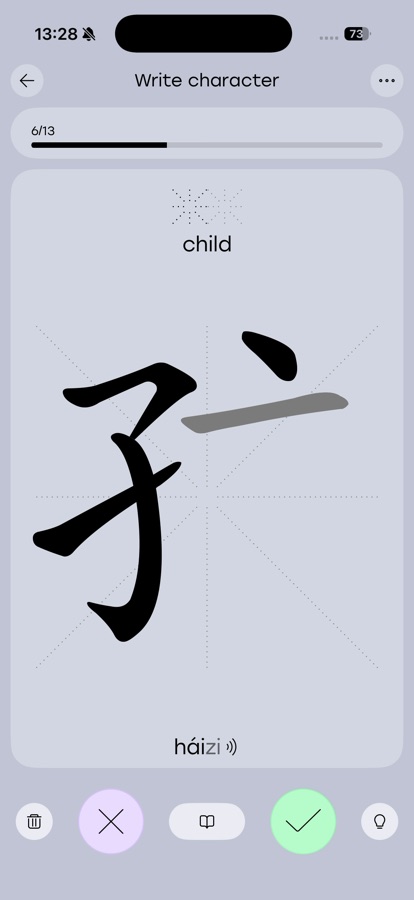
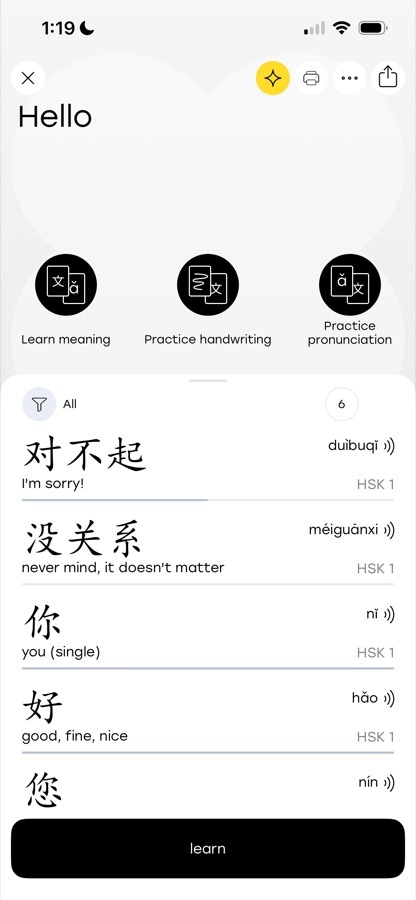
Some of it is free on the web, without a subscription. Every word in our dictionary has a page with the meaning, pinyin, an HSK label, example sentences and a stroke-order animation (press Animate), for example 字. The HSK hub lists words by level, from New HSK 1 up, and the grammar reference is free too.
Limits: there is no Mac app, so on a computer you use the free web Classroom. The pronunciation check needs an internet connection, and we don't publish a full list of what works offline. Beyond the beginner course there is no lesson-by-lesson course of grammar and dialogues. On the US App Store Laoshi has a 4.6 rating from 817 ratings. It is a subscription after a free trial: $12.99 a month, $79.99 a year or $179.99 for lifetime access on the App Store, or $12.99 a month or $69.99 a year through Laoshi's web checkout (US list prices, checked 23 November 2026).
HelloChinese: a beginner course with handwriting inside
HelloChinese is a game-like course for beginners. Its App Store listing names a pinyin course for newcomers, "Handwriting specially designed to learn Chinese characters", speech recognition, 1,000+ graded stories, and both simplified and traditional characters (App Store). Downloaded courses work offline.
Handwriting here is one part of a course, not the centre of the app. The listing does not say how writing is checked or whether stroke order is shown, and it says the courses are "based on HSK levels" without naming the HSK version. Premium is $11.99 a month, $25.99 for three months or $69.99 a year; a Premium+ tier from $19.99 is also listed, without a description of what it adds. Which lessons stay free without Premium is not stated.
Anki: a free writing deck, if you build it
Anki is free on Windows, macOS and Linux, AnkiDroid is free on Android, and AnkiWeb sync is free. The iPhone app, AnkiMobile, costs $24.99 once (App Store); its listing names SM-2 and FSRS scheduling and says study works offline.
A "handwriting deck" in Anki is a set of cards that show the meaning and pinyin on the front and the character on the back. You write the character from memory, on paper, then flip the card and rate yourself; Anki does not check your strokes. Stroke order appears only if the deck includes it. Shared HSK decks exist, but the popular "HSK 3.0" decks we looked at in October followed the 2021 standard, so count the HSK 1 words before you start: about 300 is the exam list, about 500 the 2021 standard.
Du Chinese: reading characters in context
Du Chinese is for reading and listening: graded lessons with audio and tap-to-look-up. Its App Store description promises "HSK-aligned content" without naming the HSK version, and lists offline study among the Premium features. Its pages don't mention handwriting, but reading is how recognition sticks: you meet the same characters again and again in different words.
The pricing page says "a variety of lessons are available for free"; Premium unlocks every lesson for $14.99 a month, $79.99 for six months or $119.99 a year. It runs on iOS, Android and the web.
How to learn characters with an app
Whichever app you pick, the same four habits do most of the work.
Learn the parts, not just the whole. Most characters are built from smaller parts that come back again and again, and one of them, the radical, is used to order characters in dictionaries. Once you know a few common parts, a new character stops being a picture and becomes a combination of things you know.
Follow stroke order from day one. Every character has a fixed stroke order, and a few rules cover most of it, so learning them early saves relearning later. Take 字 (zì, character, word). In the official HSK 3.0 exam list it is an HSK 1 word, and it is on the HSK 1–2 handwriting list. It has 6 strokes and follows the rule "top before bottom": first the three strokes of the roof part 宀, then the three strokes of 子 (zǐ, child) below it. Open the 字 page in our dictionary and press Animate to watch the order.

Write what you must write, recognise the rest. You will read far more characters than you write, and the HSK 3.0 numbers above show the gap: 1,200 characters to write by the top band, 3,088 to recognise. A practical split is to write the characters on your level's handwriting list and train the rest through review and reading. When you write, write from memory first and check afterwards; copying a model you can see trains your hand, not your memory.
Let spaced repetition set the schedule. Study a little every day and let the app bring each character back just before you are likely to forget it; that is what spaced repetition is for, and all six apps except Du Chinese use some form of it. Our comparison of Chinese flashcard apps explains how the schedulers differ.
Three set-ups that work
Preparing for the December HSK. A list on the exam vocabulary (Laoshi or Pleco's 2026 cards), writing practice for the characters on the handwriting list (Skritter or Laoshi), and the official sample papers in the last month. Check the levels on the HSK hub.
Starting from zero. A beginner course (HelloChinese, or Laoshi's characters course), Pleco's free dictionary for lookups, and our dictionary's stroke animation when you are unsure of the order.
Spending nothing. Anki on a computer or Android with a self-graded writing deck, Pleco's free dictionary, Du Chinese's free lessons, and the free stroke animations in our web dictionary. Our free apps article says what each "free" really includes.
Frequently Asked Questions
What is the best app to learn Chinese characters?
It depends on which half you need. For writing by hand with every stroke graded, Skritter. For reading characters in real texts, Du Chinese. For writing practice on the exact list you study, from a textbook or the HSK, Laoshi. For a free option, Anki with a deck you check yourself. Many learners combine a writing app with a reading app.
What is the best app for Chinese handwriting?
Skritter is built around handwriting and grades each stroke as you write. Laoshi gives writing practice with stroke hints on any word list and prints lists as worksheets. HelloChinese includes handwriting in its course, and Pleco's paid flashcards include handwriting fill-in-the-blank tests.
Is there a free app to learn Chinese characters?
Anki is free on computers and Android, with free AnkiWeb sync; you write on paper and rate yourself. Pleco's dictionary is free, but its flashcards are a paid add-on ($9.99). Du Chinese has free reading lessons. Laoshi's web dictionary, with stroke-order animation on every word page, is free; the Laoshi app is a subscription after a free trial.
Which apps show stroke order?
Skritter gives stroke-by-stroke feedback as you write. Laoshi shows the next stroke as a hint in the app, and its free web dictionary animates the stroke order of every word. Pleco sells stroke order diagrams as an add-on. In Anki it depends on the deck. HelloChinese and Du Chinese do not state it on the pages we checked.
How many characters do I need to write for HSK 3.0?
Far fewer than you need to read. The HSK 3.0 syllabus lists 100 characters to write by HSK 1–2, 250 by HSK 3, 400 by HSK 4, 550 by HSK 5, 700 by HSK 6 and 1,200 by HSK 7–9, against 3,088 characters to recognise across all levels.
Should I learn to write Chinese characters, or only to read them?
If you are taking the HSK, you need to write the characters on your level's handwriting list. Beyond that, it is your choice: writing slows you down at first, but it makes you notice every part of a character. Reading everything and writing a core set is a common middle way.
Sources for every claim are linked in the text and listed below. App details come from each app's own website, store listing, forum or pricing page, read on 23 November 2026.
Laoshi, an app for learning Chinese: App Store and Google Play.