


Best Chinese Flashcard Apps in 2026: Eight Apps Compared
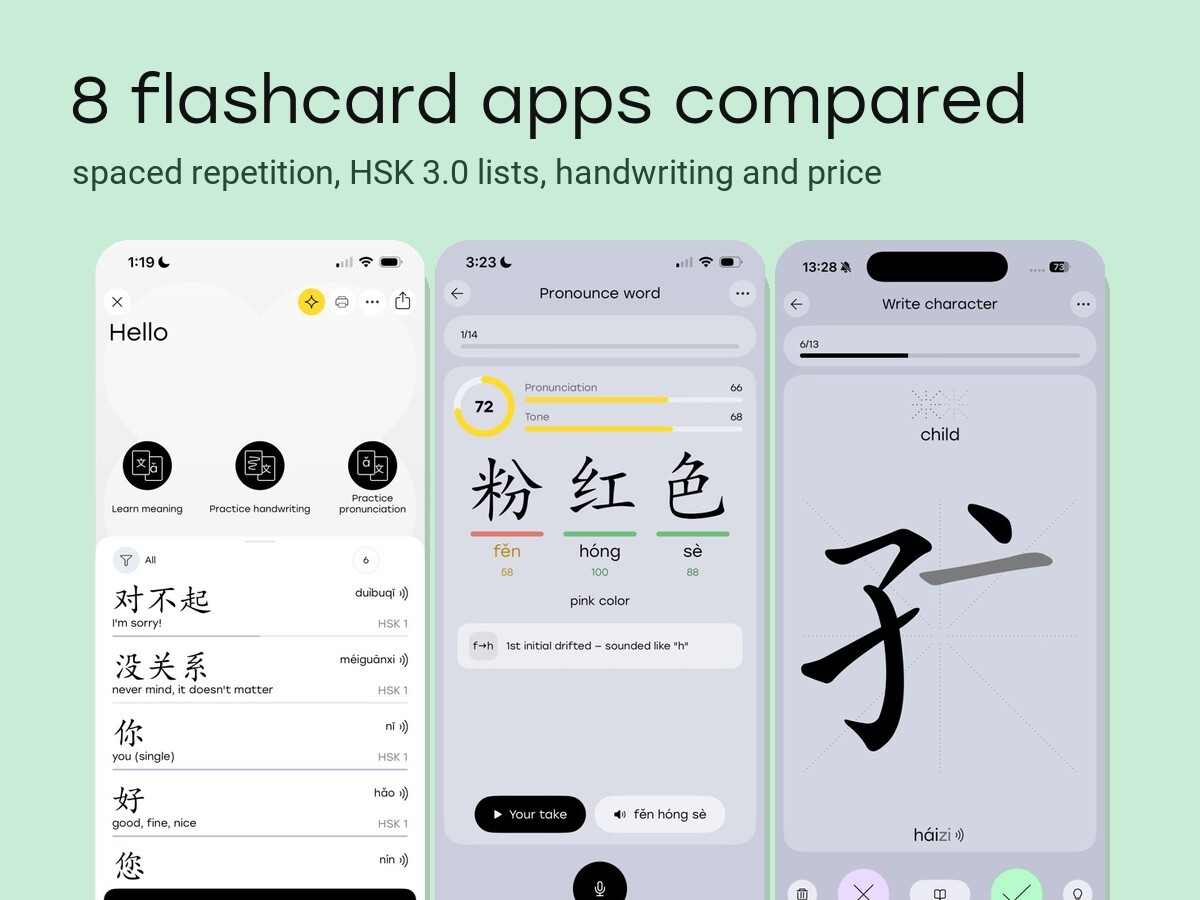
By the Laoshi team. Laoshi is our app, and it is one of the eight compared below.
Last updated: November 2026. Prices and features checked on 7 November 2026.
A flashcard app for Chinese has more work to do than one for French. Each word has a character, a reading in pinyin, a tone on every syllable and a meaning, and you may also need to write it by hand. So "which flashcard app is best" really breaks into four smaller questions:
- Does it schedule reviews for you? That is spaced repetition: a card comes back just before you are likely to forget it.
- Where do the words come from? Your own cards, other users' decks, or lists the app maintains, such as HSK levels or a textbook.
- Which HSK list? The first official HSK 3.0 exam is on 13 December 2026. Many decks labelled "HSK 3.0" follow the 2021 standard (500 words at HSK 1), not the exam syllabus published in November 2025 (300 words at HSK 1). Our HSK 3.0 word lists article explains the difference.
- Does it go beyond recognition? Audio, tone practice and handwriting are where Chinese apps differ most.
Short answer by need:
- Free, fully customisable, works offline: Anki
- You already use Pleco as your dictionary: Pleco's Flashcard System add-on
- Learning to write characters by hand: Skritter
- Reading-first vocabulary in the browser, with HSK 3.0 (2026) lists: Hack Chinese
- HSK-only cards with a free daily allowance: HSKLord
- Vocabulary from your textbook, plus pronunciation and writing practice: Laoshi
- Sharing simple sets with a class: Quizlet
- A guided phrase course rather than a deck: Memrise
How we checked
On 7 November 2026 we read each app's official website, its US App Store listing and, where relevant, the developer's own forum or release notes. We did not run timed tests, and we have not ranked the apps against each other. Where an app does not state something, the table says "not stated" rather than guessing. Prices are US list prices on that date; store prices differ by country, and some apps show several price points for the same plan.
Comparison table
| App | Best for | Spaced repetition | HSK 3.0 lists (Nov 2026) | Audio / handwriting | Platforms | Offline | Price (US, checked 7 Nov 2026) |
|---|---|---|---|---|---|---|---|
| Anki | Free DIY decks | Yes (SM-2 or FSRS) | Community decks only | Audio if the deck has it / no handwriting grading | Windows, macOS, Linux, iOS, Android, web sync | Yes (AnkiMobile) | Free; iOS app $24.99 once |
| Pleco | Dictionary users | Yes, in paid Flashcard System | Premade cards for the 2026 test (v3.2.82) | Free TTS, paid recordings / handwriting tests in study modes | iOS, Android | Not stated on current pages | Flashcard System $9.99, or Basic Bundle $29.99, one-time |
| Skritter | Handwriting | Yes | HSK 3.0 decks on the 2021 standard (listing names levels 1–3); 2026 decks in progress | Not clearly stated / stroke-by-stroke grading | Web, iOS, Android | Yes, with Premium | $14.99/mo, $59.99/6 mo, $99.99/yr; 7-day free trial |
| Hack Chinese | Reading vocabulary | Yes | "HSK 3.0 (2026)" list, plus the 2021 framework marked superseded | Not stated / no handwriting | Web only (mobile browser) | Not stated | $18/mo, or $12/mo billed yearly; 21-day trial |
| HSKLord | HSK-only cards | Yes | HSK 1–9; study-list version not stated (practice tests use official exam lists) | Tap-to-listen audio / not stated | Web, iOS, Android | Not stated (printable PDFs sold) | Free 10 new cards/day; $12/mo or $79/yr on web; iOS $14.99, $99.99/yr |
| Laoshi | Textbook vocabulary, pronunciation, writing | Yes | Official exam lists (chinesetest.cn), incl. 7–9; HSK 2.0 too | Text-to-speech audio, sound and tone scores / stroke hints | iOS, Android; free web Classroom | Pronunciation check needs internet; rest not stated here | $12.99/mo or $69.99/yr via web checkout; App Store plans from $5.99/week to $179.99 lifetime |
| Quizlet | Simple shared sets | "Resurfaces" what you need to review | User-made sets only | Not stated / no handwriting | Web, iOS, Android | Not stated | Free with ads; Plus in-app $9.99 and $44.99 |
| Memrise | Guided phrase course | Review prompts by algorithm | Not stated | Native-speaker videos / no handwriting | Web, iOS, Android | Not stated on listing | Free plan; Pro $24.99/mo, $61.99/yr, $329.99 lifetime |
Anki: best free option, if you build it yourself
Anki is free on Windows, macOS and Linux, AnkiDroid is free on Android, and AnkiWeb sync is free. The iPhone app, AnkiMobile, costs $24.99 once, "no subscription, no sync fees" (App Store). The listing names both SM-2 and FSRS scheduling and says study works offline, with media stored on the device.
Anki knows nothing about Chinese until you give it a deck. Shared HSK decks exist on AnkiWeb, but the popular HSK 3.0 ones we looked at in October followed the 2021 standard. Open the HSK 1 deck and count: around 300 words is the exam list, around 500 is the 2021 standard, around 150 is the old HSK. Tone colouring, audio and handwriting all depend on the deck and add-ons you choose.
Pick Anki if you enjoy control and don't mind setup time.
Pleco: flashcards inside the dictionary
Most learners already have Pleco as a dictionary. Its flashcards are a paid add-on: the Flashcard System is $9.99 on its own, or part of the $29.99 Basic Bundle; the $59.99 Professional Bundle adds more. All are one-time purchases (App Store). You can make a card from any dictionary entry with one tap, import lists, and study with spaced repetition, handwriting fill-in-the-blank and tone drills.
Version 3.2.82 "added vocabulary for the refreshed 2026 HSK 3.0 test" to Pleco's premade cards. Free audio uses the phone's built-in text-to-speech; native-speaker recordings are a $4.99 add-on. The setup is dense, and Pleco does not tell you what to learn next.
Skritter: best for writing characters
Skritter asks you to write each character stroke by stroke and grades the strokes as you go. Reviews run on spaced repetition, and the listing mentions 700+ decks, including chapter-by-chapter textbook decks and TOCFL (App Store). Premium covers web, mobile and offline use.
On HSK, the App Store listing names HSK 3.0 levels 1 to 3 and every HSK 2.0 level. Skritter's HSK 3.0 decks were announced in June 2021 and follow the 2021 standard (forum). In its forum, the latest staff post (20 October 2026) says 2026 HSK 3.0 lists are still "being organized and updated" (forum).
On its website Premium is $14.99 a month, $59.99 for six months or $99.99 a year, each with a 7-day free trial; the App Store listing also shows lower and higher price points for the same periods. Skritter is about writing and recall; its listing does not mention grammar lessons.
Hack Chinese: reading vocabulary in the browser
Hack Chinese is built around spaced repetition for recognising words, and says so plainly: asked whether you will learn to hand-write characters, its pricing page answers "No." It starts by estimating the words you already know, so you don't re-learn HSK 1. Its list catalogue includes HSK 3.0 (2026), with the 2021 framework kept but labelled "Superseded", plus textbook and graded-reader lists (lists).
There is no iOS or Android app yet; you use it in a phone or desktop browser. It costs $18 a month, or $12 a month billed yearly, after a 21-day trial with no card, and has a 30-day refund policy.
HSKLord: HSK cards with a free daily allowance
HSKLord does one thing: HSK vocabulary cards with spaced repetition, each with pinyin, meaning, an example sentence and audio. The free plan gives 10 new cards a day with unlimited reviews. Premium is $12 a month or $79 a year on the web; the iOS app lists $14.99 a month and $99.99 a year (App Store).
It covers HSK 1 to 9 (10,978 words in its study lists) but does not say which HSK 3.0 list the study cards follow, so check the HSK 1 word count before you rely on it; it does say its Premium practice tests are built from the official exam word lists. Handwriting is not mentioned, and for offline study it offers printable PDF vocabulary packs. HSKLord also publishes its own comparison of Chinese flashcard apps, which lists HSKLord as #1.
Laoshi: textbook vocabulary, pronunciation and writing
Laoshi is our app, so weigh this section with that in mind.
Laoshi is an app for learning Chinese; its flashcards come with two kinds of ready-made word lists. Its HSK 3.0 decks follow the official exam vocabulary from chinesetest.cn, the test operator's site, including the 7–9 band, with HSK 2.0 lists kept alongside. And it has a textbook library of 71 series split into 4,474 lesson lists, such as HSK Standard Course and New Practical Chinese Reader, so you can study exactly this week's lesson. You can also make your own lists, or bring lists from Anki, Quizlet or Pleco: export them as text and paste them into Laoshi Classroom, our web app. Reviews run on spaced repetition, and our website has a free grammar reference.
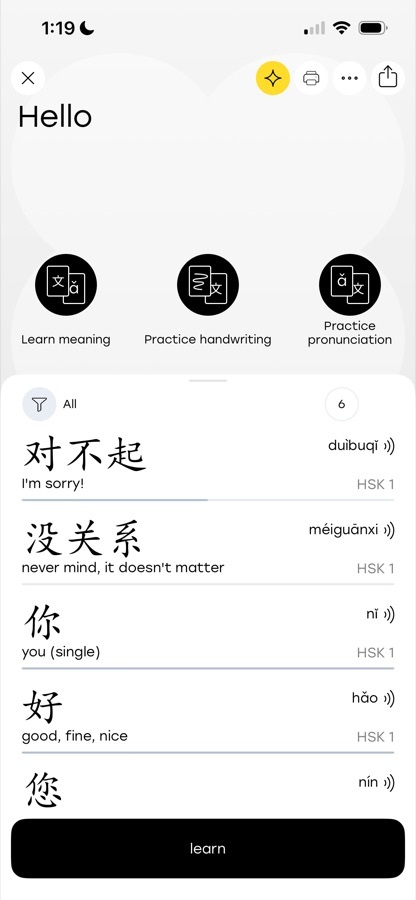
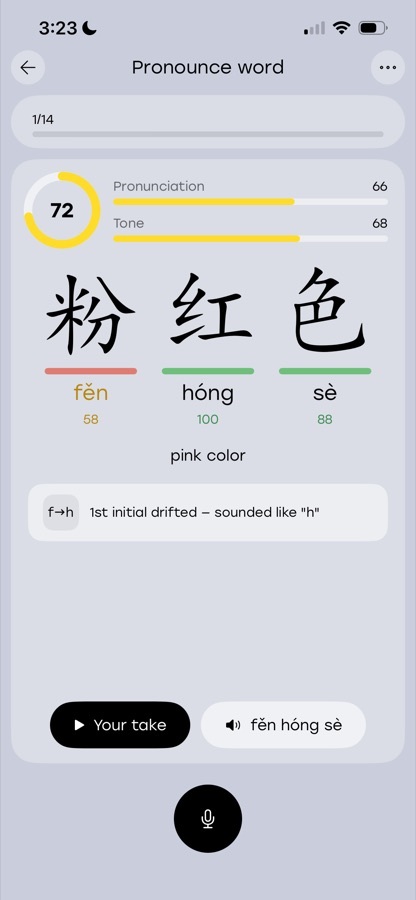
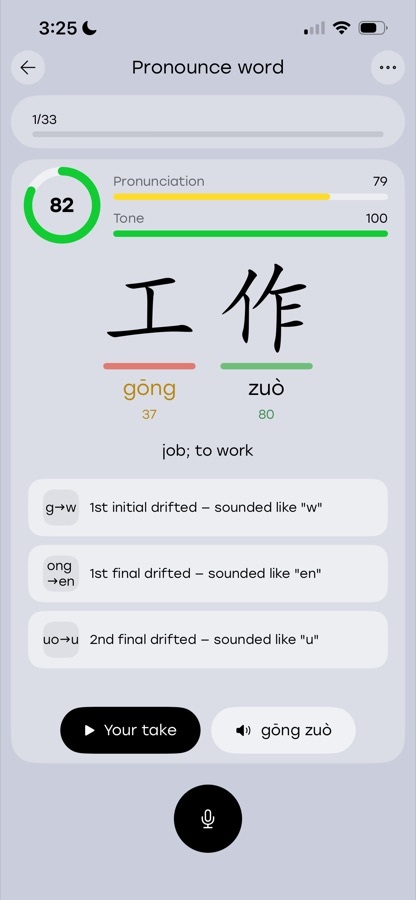
Two practice modes go beyond flip cards. Pronunciation check scores what you say character by character, with one score for the sounds and one for the tones, so a right vowel with the wrong tone shows up as a tone error, as in mǎi (买, buy) said as mài (卖, sell). Character writing gives stroke hints: one tap shows the next stroke, a double tap the whole character. Both work on any list, including your own.
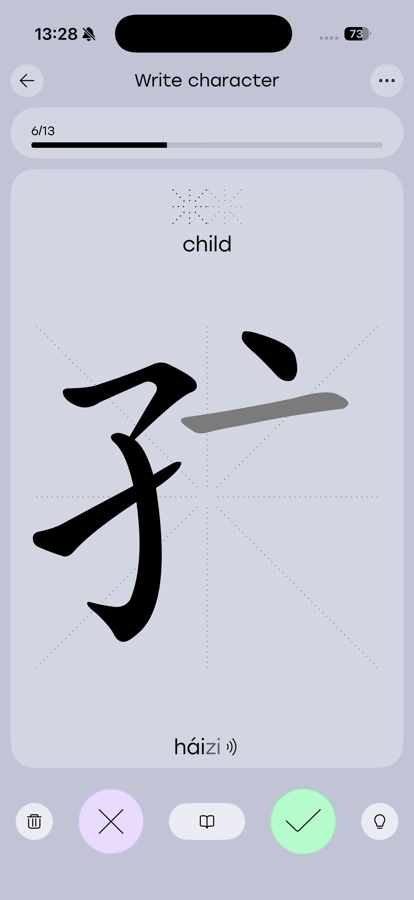
Limits: there is no Mac app, so on a computer you use the free web Classroom, which has simpler flashcards than the phone apps. Pronunciation check needs an internet connection. On the US App Store Laoshi has a 4.6 rating from 807 ratings. It is a subscription: $12.99 a month or $69.99 a year through Laoshi's web checkout; App Store plans range from $5.99 a week to a $179.99 lifetime purchase (US list prices, checked 7 November 2026).
Quizlet: simple sets you can share
Quizlet is a general study app, not a Chinese one. Its strength is sharing: a teacher makes a set and the whole class uses it. The App Store listing says Quizlet "intelligently resurfaces exactly what you need to review", but the listing mentions no tone, character or handwriting features, and the HSK sets are made by users, so quality varies (App Store). The free version shows ads; the listing's Plus plans are $9.99 and $44.99, without billing periods shown. Quizlet's own pricing page blocked our check.
Memrise: a course with review, not a deck
Memrise's Chinese offering is a course its page says is "created by expert linguists", teaching pinyin and characters with videos of native speakers. On the App Store, the developer says review prompts appear "when our algorithm predicts" you are about to forget (App Store). The listing does not mention HSK or building your own deck. There is a free plan; Pro is $24.99 a month, $61.99 a year or $329.99 for life on the US App Store, with other offer prices also listed.
Good for everyday phrases; not the tool for exam vocabulary.
Three set-ups that work
Preparing for the December HSK. A deck on the exam list (Hack Chinese, Pleco's 2026 cards, or Laoshi), plus handwriting practice from HSK 2 up (Skritter or Laoshi), plus the official sample papers in the last month.
Following a class textbook. Lesson-by-lesson lists (Laoshi, or Skritter's and Hack Chinese's textbook decks), learned before each class and kept in review.
Spending nothing. Anki on desktop or Android with a deck you have checked against the 300-word HSK 1, Pleco's free dictionary, and HSKLord's 10 free new cards a day.
Frequently Asked Questions
Is Anki better than Quizlet for Chinese?
For most learners, yes. Anki schedules every card with spaced repetition (SM-2 or FSRS), AnkiMobile states offline study, and Anki is free outside iOS, and Chinese decks can carry audio and tone colours. Quizlet is easier for sharing sets with a class, but it has no Chinese-specific features and its HSK sets are user-made.
Which flashcard app uses HSK 3.0 lists?
Among the eight here, as of 7 November 2026: Pleco has premade cards for the 2026 HSK 3.0 test; Hack Chinese has an "HSK 3.0 (2026)" list; Laoshi's HSK 3.0 decks follow the official exam vocabulary from chinesetest.cn, including levels 7–9. Skritter's current HSK 3.0 decks follow the 2021 standard, with 2026 decks in progress. HSKLord covers HSK 1–9 without naming the version of its study lists, though it says its Premium practice tests use the official exam lists. Anki and Quizlet depend on the user deck, and Memrise does not mention HSK.
Is there a free Chinese flashcard app with spaced repetition?
Anki is free on desktop and Android, with free AnkiWeb sync. HSKLord's free plan gives 10 new HSK cards a day with unlimited reviews. Pleco's dictionary is free, but its spaced-repetition flashcards are a paid add-on ($9.99).
Which flashcard app helps with handwriting Chinese characters?
Skritter is built around writing and grades each stroke. Pleco's paid flashcards include handwriting fill-in-the-blank tests. Laoshi has character writing with stroke hints on any list. Hack Chinese says it does not teach handwriting.
Can I move my Anki, Quizlet or Pleco cards to another app?
Usually, as text. Pleco and Anki both export lists. Laoshi takes a pasted text list in its web app, Laoshi Classroom, and the list then appears in the phone app under the same account. Check that tone marks survive the export.
Do Chinese flashcard apps work offline?
AnkiMobile states offline study, and Skritter Premium includes offline support. Hack Chinese runs in the browser. Laoshi's pronunciation check needs a connection, and HSKLord sells printable PDF packs for offline study. The other apps here do not state it on the pages we checked.
Sources for every claim are linked in the text and listed below. App details come from each app's own website, store listing, forum or release notes, read on 7 November 2026.
Laoshi, an app for learning Chinese: App Store and Google Play.