


Chinese Sentence Structure: The Word Order Rules That Always Hold
By the Laoshi team. We maintain a grammar reference of 756 rules for Chinese, 212 of them on sentence structure, and this guide is drawn from it.
Last updated: October 2026.
Chinese has no cases, no verb conjugation and no agreement. Word order carries the work all of that does in other languages. Change the order and you change the meaning, not just the emphasis — which is why "learn the patterns" is better advice for Chinese than "learn the endings."
The good news is that the patterns are finite and they stack. Four rules hold across almost every sentence you will build, and the rest is knowing which slot each new piece goes into.
The four rules that never break
| Rule | In practice |
|---|---|
| Subject comes before the predicate | 我是学生 — I am a student |
| Time comes first, then place, both before the verb | 冬天我们去法国 — in winter we go to France |
| A modifier always comes before what it modifies | 红色的车 — the red car, never "car red" |
| Known information comes first, new information last | the topic you are already talking about opens the sentence |
Everything below is an application of these four.
The basic frame
The frame most simple sentences are built on:
Subject + Predicate + Object
他 + 吃 + 苹果 — tā chī píngguǒ — He eats an apple.
That is the whole skeleton. A Chinese sentence can also run without a verb at all, which surprises most beginners: 我很忙 — wǒ hěn máng — "I very busy" is complete and correct. The predicate there is an adjective, and no verb "to be" appears. Two of them can be set side by side with no connector: 我的行李箱重,你的轻 — my suitcase is heavy, yours is light. We cover that as verbless sentences, and there is a related pattern with no subject-predicate pair at all, which is how you get one-word sentences like 下雨了 — it's raining.
The extended frame
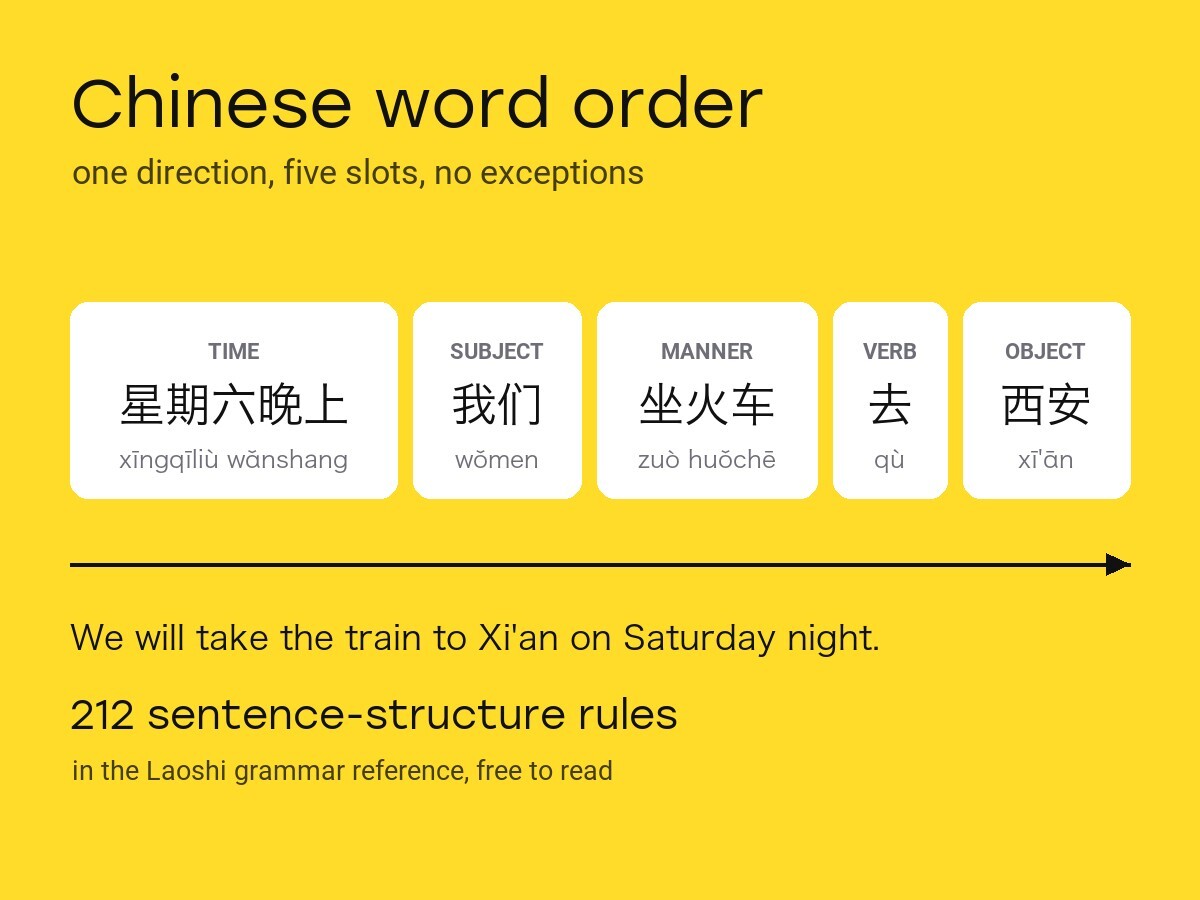
Once you add time, place and manner, the slots fill in a fixed order:
Time + Subject + Place + Manner + Predicate + Object
星期六晚上我们坐火车去西安 xīngqīliù wǎnshàng wǒmen zuò huǒchē qù xī'ān We will take the train to Xi'an on Saturday night.
Read the Chinese left to right and the logic is: Saturday night — we — by train — go — Xi'an. English scatters those pieces; Chinese stacks them in one direction.
Time is the one slot with freedom: it can sit before or after the subject. 冬天我们去法国 and 我八点起床 are both standard. What it cannot do is come after the verb. Details in the position of words indicating time.
Negation
Negation is a particle placed before the verb, not a change to the verb:
- 不 for the present and future, and for habits: 我不喜欢游泳 — I don't like swimming. 他不是医生 — he is not a doctor.
- 没 for the past, and always with 有: 他没有笔 — he doesn't have a pen.
The choice between them is the single most common beginner mistake in Chinese, and it is not about politeness or strength — it is about time and completion. See negative sentences and the negative particles.
Questions
Chinese does not invert word order to ask a question. The statement stays exactly as it is and you add something:
- 吗 at the end turns any statement into a yes-no question: 你是中国人吗? — are you Chinese?
- Repeating the verb in positive-negative form asks the same thing: 你认识不认识我妹妹? — do you know my sister?
- 是不是 and 是否 make tag questions: 这地毯质量很好,是不是? — this carpet is good quality, isn't it?
- 呢 asks "and what about…?" with no verb at all: 你好吗?—— 我很好,你呢?
This is why Chinese questions feel easy after European languages: there is no re-ordering to learn. Start with interrogative sentences, then the particle 呢 and tag questions.
Comparisons
Comparison is a structure, not an adjective ending. There is no "-er" in Chinese. The main frame is 比:
A + 比 + B + adjective
哥哥比我高 — gēge bǐ wǒ gāo — My older brother is taller than me.
Then there are the variants: 有 for "as much as" (哥哥有我高), 不如 for "not as good as" (这个房子不如那个房子大), 一样 for "the same as" (两座楼完全一样), 似的 for "like". Each is a separate pattern with its own word order, and mixing them up is a reliable way to say the opposite of what you meant. We index them together under how to compare sentences, with 比, 有, 不如 and 一样 each written up on its own.
Two verbs in one sentence
Chinese stacks verbs without any connector. 她去商店买东西 — "she goes to the shop buys things" — is not two clauses and needs no "and" or "to". The verbs run in the order the actions happen: 我来中国学习汉语 — I came to China to study Chinese. Reversing them does not give you a different nuance, it gives you something that is not a sentence. See sentences with two verbs.
What order to learn these in
Sentence patterns are not all beginner material, and they are not all advanced. Graded against the HSK 3.0 standard, our 212 sentence-structure rules spread like this:
| HSK 3.0 level | Sentence-structure rules |
|---|---|
| Level 1 | 15 |
| Level 2 | 20 |
| Level 3 | 24 |
| Level 4 | 30 |
| Level 5 | 28 |
| Level 6 | 17 |
| Levels 7–9 | 36 |
The shape of that table is the practical point. The patterns do not taper off after the beginner levels — the heaviest blocks are at levels 4, 5 and the 7–9 band. If sentence structure feels like something you finished in your first months, that is usually a sign of a plateau rather than mastery.
At level 1 the list is short enough to name in full: the basic frame, verbless sentences, sentences with no subject-predicate pair, negation, interrogative sentences, the particle 呢, the position of time words, dates, months, days of the week, telling the time, the first comparison pattern, two verbs in a row, complete versus incomplete sentences, and the 有的…有的… structure. That is fifteen patterns — the whole grammatical toolkit for HSK 1. Everything else at that level is vocabulary.
Frequently asked questions
Is Chinese word order the same as English?
For the simplest sentences, yes: subject, verb, object. The divergence starts as soon as you add anything. Time and place go before the verb in Chinese and after it in English, and modifiers always precede what they modify. "In winter we go to France" becomes 冬天我们去法国 — literally "winter we go France," with the time word opening the sentence.
Does Chinese have tenses?
No. Time is carried by time words (明天, 昨天), by aspect particles like 了 and 过, and by context. The verb itself never changes form. This is why the position of time words matters more in Chinese than in most languages — it is doing the work a tense would.
Can I move words around for emphasis?
Sometimes, and it is called inversion (倒装句). It is a real device, but it is stylistic and marked — it colours the sentence emotionally and is carried by intonation in speech. It is not a free alternative to the standard order, and it is not where beginners should start.
How many sentence patterns do I actually need?
Fifteen will get you through HSK 1. Around 59 cover HSK 1–3. The full set through the 7–9 band runs to 212 in our reference, out of 756 grammar rules in total.
Where can I look these up?
Our Chinese grammar reference is free to read, no account needed, and every rule carries examples with pinyin and translations. The sentence structure section is the subset this guide walks through.
A note on where this comes from
We are Laoshi, a Chinese learning app built around vocabulary from published textbooks and HSK word lists. The grammar reference is the part of our work that sits outside the app and outside the paywall: 756 rules, each with examples, cross-referenced to HSK levels in both the old and the new standard.
We are telling you that because it explains the shape of this guide. We did not write it to be a complete grammar of Chinese — it is a map of the one area learners most often think they have finished, with the actual count of what is left.