


Best Apps to Practise Mandarin Tones in 2026: Eight Tools Compared
By the Laoshi team. Laoshi is our app, and it is one of the eight compared below.
Last updated: November 2026. Prices and features checked on 11 November 2026.
You can know that 买 mǎi means "buy" and 卖 mài means "sell" and still say one when you mean the other. To practise tones you need something that hears you and tells you what came out. The tools here give three very different kinds of answer:
- A pitch line. The tool draws the shape of your voice next to the target shape. You see a third tone that never dips, but you judge it yourself.
- A score. The tool rates each syllable, sometimes with the tone rated apart from the consonant and vowel, and sometimes with the mistake named in words.
- A tutor's correction. An AI or human tutor reacts to what you said in conversation.
A fourth kind of practice doesn't listen to you at all: drills that make you hear tones or remember which tone a word has. They help, but they won't tell you how you sound.
Short answer by need:
- See your pitch against the target: SayMei's Tone Checker (browser, free), Praat (computer, free) or MandaTone (phone, free to start, then a subscription)
- A tone score for every syllable, plus pronunciation-only drills: TonePerfect
- Sound and tone scores on the words you are already studying, from a textbook or your own lists: Laoshi
- Speaking out loud with an AI tutor: SayMei or SuperChinese (CHAO plan)
- A full beginner course with speech recognition built into lessons: HelloChinese or SuperChinese
- Remembering which tone each word has, without speaking: Pleco's Tone Practice flashcards
How we checked
On 11 November 2026 we read each tool's official website, its US App Store listing and, for Pleco and Praat, the developer's own manual. We did not test how accurate any app's speech recognition is, ours included, and we have not ranked the apps against each other. Where a page does not say something, for example whether feedback is given per syllable, the table says "not stated" rather than guessing. Prices are US list prices on that date; store prices differ by country, and several apps list more than one price for the same plan.
Two of the tools here, TonePerfect and SayMei, publish their own comparisons of Chinese learning apps and say in them that they are comparing their own product. This article is the same kind of page, written by the Laoshi team.
Comparison table
| Tool | Best for | Listens to you? | Tone feedback you get | Platforms | Price (US, checked 7 Nov 2026) |
|---|---|---|---|---|---|
| TonePerfect | Pronunciation-only practice | Yes | A score for each syllable's tone, initial and final | iOS, Android, web | Free tier; Premium $9.99/mo or $69.99/yr on the web; App Store prices vary, $4.99/wk to $198.99 lifetime |
| SayMei | Talking with an AI tutor in the browser | Yes | Tone Checker: your pitch line next to a reference voice, no score; tutor corrections in lessons (tone detail not stated) | Web, iPhone | First lesson and tools free; Premium $5.99/mo for 200 tutor minutes |
| MandaTone | Seeing your pitch on a phone | Yes | Your pitch curve overlaid on a native model, with colour-coded scores and AI coach notes; per-syllable detail not stated | iPhone, Android | Free download with in-app purchases; App Store $9.99/mo or $59.99/yr; its website shows Coach at $12.99/mo or $79.99/yr |
| Laoshi | Tones on textbook and own word lists | Yes | Separate sound and tone scores for each attempt, a score for each character, the slip named in words | iOS, Android | App Store $12.99/mo, $79.99/yr after a 7-day trial, $179.99 lifetime |
| SuperChinese | A course with an AI teacher | Yes, in lessons | An AI tutor that "lets you know where you need to improve"; per-tone detail not stated | iOS, Android | PLUS $11.99/mo, $59.99/yr, $139.99 lifetime; CHAO $24.99/mo or $109.99/yr |
| HelloChinese | A beginner course | Yes, in lessons | "Speech recognition corrects your pronunciation"; per-tone detail not stated | iOS, Android | Free tier; Premium $11.99/mo, $25.99/3 mo, $69.99/yr |
| Pleco | Remembering tones of words | No | You tap the tone of each syllable; the card is graded | iOS, Android | Flashcard System add-on $9.99 one-time |
| Praat | A free pitch graph on a computer | Records, does not grade | A pitch contour of any recording; you compare it yourself | macOS, Windows, Linux, Chromebook | Free, open source |
TonePerfect: a score for every syllable
TonePerfect is a pronunciation coach, not a course. Its site says it "focuses on pronunciation, not vocabulary or grammar". You say a word or sentence and each syllable is scored for its tone, its initial and its final, so you can tell a wrong tone from a wrong vowel. It adds a two-minute placement test, drills for tones, tone pairs, initials, finals and tone changes, listening games, and practice on any text you type (App Store). The same app covers seven other languages.
None of the TonePerfect pages we read mention a pitch graph; the feedback is described as scores and tips. It runs on iPhone, Android and in the browser, and its free browser test needs no account. The free plan gives "at least one free guided practice session each day". Premium is $9.99 a month or $69.99 a year by card on the web; the App Store lists several other price points, from $4.99 a week to $198.99 for life (pricing).
Pick it if you already have vocabulary from elsewhere and want a focused pronunciation trainer.
SayMei: an AI tutor and a free pitch checker in the browser
SayMei is built around Mei Lin, an AI tutor you talk to out loud in Mandarin. Its homepage says she "answers what you said, corrects you as you go" in 5 to 10 minute lessons, from a library of 1,800+ lessons across HSK 1 to 6. The page does not say how detailed her tone corrections are.
For tones specifically, SayMei has two free tools that need no account. The Chinese Tone Checker plays a word, records you, and shows "your pitch line next to the reference voice". It checks one word at a time, judges only the pitch shape and "gives no score"; it tells you which tone your voice resembled. The tone pair trainer drills the 20 two-syllable tone combinations by ear; the homepage says it includes third-tone sandhi and the tone changes on 一 and 不.
SayMei runs in a browser and, since 10 November 2026, in an iPhone app. The first lesson is free without an account or card. Premium is $5.99 a month for 200 minutes with Mei Lin, after a 7-day trial that needs a card (pricing).
MandaTone: your pitch curve on a phone
MandaTone is a small Mandarin tone app for iPhone and Android. Its App Store listing says you can "compare your pitch curve with a native model" and "overlay your voice with a native model", with colour-coded score chips and an AI coach that suggests what to practise next (App Store). Practice covers the four tones, tone contrast and tone sandhi, and you train recognition before you speak. The pages we read do not say whether each syllable gets its own tone score.
The download is free, and the website says the free part includes a placement diagnostic, a pronunciation check and a first coach plan. The US App Store lists Pro and Coach plans at $9.99 a month or $59.99 a year; MandaTone's website shows Coach at $12.99 a month or $79.99 a year. The app is new and actively updated: it first came out in spring 2026, had five App Store releases in October, and both store apps were updated on 10 November 2026. It has very few store ratings so far.
An older free option, Cantone, also plots your attempts against standard tone contours, in Mandarin and Cantonese, but its iOS app has not been updated since February 2023.
Laoshi: sound and tone scores on the words you study
Laoshi is our app, so weigh this section with that in mind.
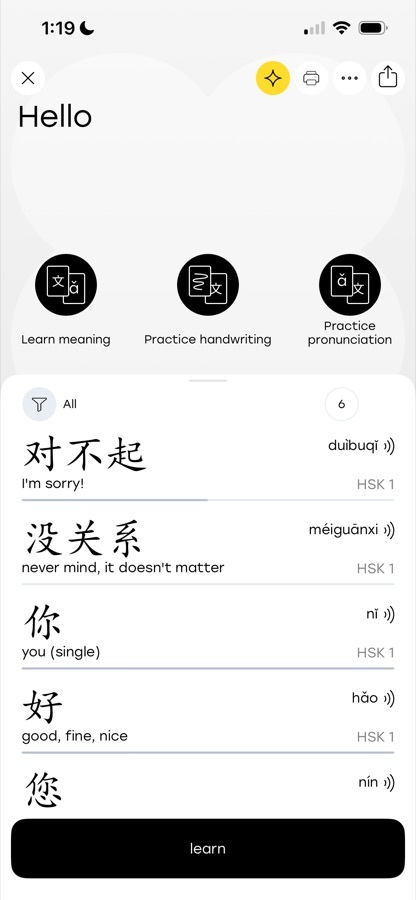
Laoshi is an app for learning Chinese: word lists from 71 textbook series, HSK lists, spaced-repetition review and character writing. Its pronunciation check works on any of those lists, including lists you make yourself. You open a list, start pronunciation practice, tap the microphone and say the word or the whole phrase.
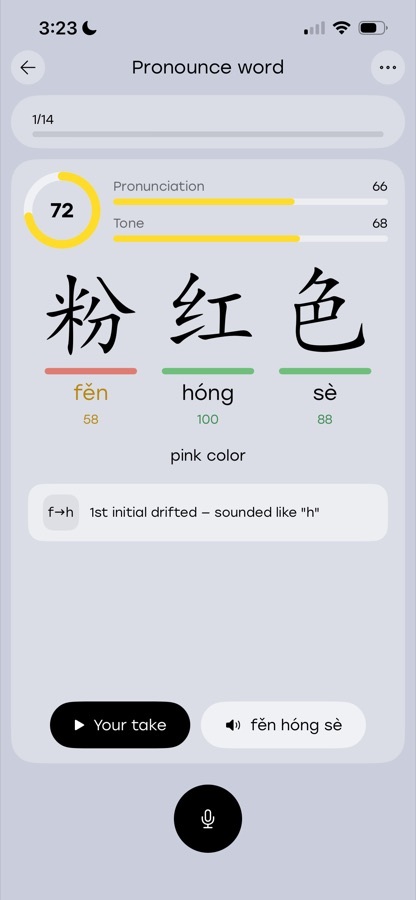
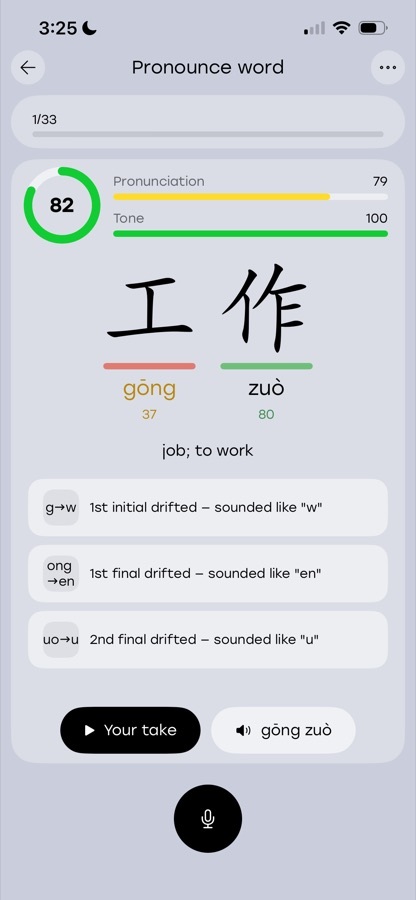
Each attempt comes back with an overall score and two separate scores, one for the sounds and one for the tones, and every character is marked with its own score and colour. The mistake is named in words, for example that the first initial drifted and sounded like h, that a syllable was skipped, or that a tone did not change before the next word. So a right vowel with the wrong tone, such as mǎi said as mài, shows up in the tone score rather than as a vague low mark. You can play the reference audio and then your own recording.
Limits: Laoshi does not draw a pitch graph, and it does not score fluency, rhythm or the intonation of a whole sentence; the scores are for sounds and tones. The pronunciation check needs an internet connection, and Laoshi is a subscription app. On the US App Store Laoshi has a 4.6 rating from about 800 ratings. App Store prices are $12.99 a month, $79.99 a year after a 7-day free trial, or $179.99 for lifetime access (US list prices, checked 11 November 2026).
SuperChinese: a course with an AI teacher
SuperChinese is a full course: over 400 lessons in 9 levels, with speaking, reading, writing and spaced repetition. Its App Store listing promises help to "pronounce words in the right tone" and says "your AI language tutor lets you know where you need to improve" (App Store). The pages we read do not say whether tone is scored separately from the sounds. The CHAO plan adds an AI teacher you can practise speaking with; the site says CHAO "gives you more opportunities to practice real-world conversations through role-plays and everyday scenarios".
US in-app prices include PLUS at $11.99 a month, $59.99 a year or $139.99 for life, and CHAO at $24.99 a month or $109.99 a year; other price points for the same plans are also listed.
HelloChinese: speech recognition inside a beginner course
HelloChinese is a game-like course for beginners, with a pinyin course, 2,000+ videos of native speakers and graded stories. Its listing says "speech recognition corrects your pronunciation" and that downloaded courses work offline (App Store). It does not describe per-syllable or per-tone feedback. There is a free tier; Premium is $11.99 a month, $25.99 for three months or $69.99 a year. A Premium+ tier is also listed in the store; the listing doesn't say what it adds.
Good if you are starting from zero and want speaking practice inside lessons.
Pleco: drilling which tone a word has
Pleco's paid Flashcard System ($9.99 one-time, or in the $29.99 Basic Bundle) includes a Tone Practice test (App Store). Its manual describes it: the card shows the word "without tone marks; you'll be prompted to enter the correct Mandarin tone for each syllable" (manual). Pleco does not record you. It trains your memory of each word's tone: you can't say a tone right if you don't know which one it is.
Praat: a free pitch graph on a computer
Praat is free, open-source software that phoneticians use, for macOS, Windows, Linux and Chromebook. Its manual explains how to view "the pitch contour of an existing sound" (manual). Record yourself and a native recording of the same word, open both, and compare the two lines. There is no score or advice, and the interface is built for researchers, but it shows exactly what your voice did.
A routine that works without a teacher
Ten minutes a day. Two minutes of listening drills (SayMei's tone pair trainer, or MandaTone's recognition practice), then say the words you are learning this week and check them with a tool that listens (TonePerfect, Laoshi, MandaTone or SayMei's Tone Checker). Repeat only the syllables marked wrong.
Say phrases, not single syllables. Tones change in connected speech: third tone before third tone, 一 and 不 before other tones. Practise two- and three-syllable words and short phrases once single tones feel easy.
Check the checker. Record the same phrase in two tools, or compare your recording with a native one in Praat. If they disagree, listen to yourself before trusting either.
Frequently Asked Questions
Is there an app that tells me if my Mandarin tones are right?
Yes. TonePerfect scores each syllable's tone separately from its initial and final. Laoshi gives separate sound and tone scores for each attempt and a score for each character, with the mistake named in words. SayMei's free Tone Checker shows your pitch line against the target instead of a score, and MandaTone overlays your pitch curve on a native model. SuperChinese and HelloChinese include speech recognition in their lessons, but their pages don't say whether tone is scored on its own.
How do I practise tones without a teacher?
Combine listening drills with a tool that hears you. Train your ear on tone pairs, then say the words you are studying and check them with an app that marks each syllable. Move from single syllables to two-syllable words and short phrases.
Can an app show my pitch contour?
MandaTone overlays your pitch curve on a native model on iPhone and Android, and SayMei's Tone Checker shows your pitch line next to a reference voice in the browser. On a computer, Praat draws the pitch contour of any recording. TonePerfect and Laoshi give scores rather than a graph.
Is there a free app to check Mandarin tones?
SayMei's Tone Checker and tone pair trainer are free in the browser without an account. TonePerfect has a free daily session and a free browser test. Praat is free desktop software. MandaTone has a free start, with a subscription for the full app.
Do these apps check tone sandhi?
TonePerfect lists drills for tone changes. SayMei's tone pair trainer covers third-tone sandhi and the changes on 一 and 不. MandaTone lists tone sandhi practice. Laoshi's notes can point out a tone that should have changed before the next word.
Are AI tone scores accurate?
We did not test accuracy, and none of the pages we read publish an independent accuracy test. SayMei publishes its own figure for the Tone Checker, 84% correct on recordings from computer-generated voices, and says it has not been tested on human voices. Treat a score as a pointer to what to listen to again, and check it against a native recording.
Sources for every claim are linked in the text and listed below. App details come from each tool's own website, store listing or manual, read on 11 November 2026.
Laoshi, an app for learning Chinese: App Store and Google Play.