


Duolingo Alternatives for Chinese in 2026: Which App Fits Your Reason
By the Laoshi team. Laoshi is our app, and it is one of the eight alternatives below.
Last updated: November 2026. Duolingo's pages, prices and features checked on 7 November 2026.
Duolingo is where many people start Chinese: the course is free, the lessons are short and the streak keeps you coming back. People who look for something else usually have one of four reasons:
- Characters. You can recognise hanzi in a lesson but want to write them by hand.
- Tones. You want an app that tells you which tone came out wrong.
- HSK. You have an exam date and want to study the exact word list for your level.
- Depth and structure. You follow a textbook or a class, or you want graded reading beyond single sentences.
Each reason points to a different app, and you can keep Duolingo for the daily habit and add one.
Short answer by reason:
- Writing characters by hand, stroke by stroke: Skritter
- Feedback on your tones and sounds on the words you are studying, plus writing with stroke hints: Laoshi
- Another full beginner course, built only for Chinese: HelloChinese or SuperChinese
- Word lists for the 2026 HSK 3.0 exam, for vocabulary review: Hack Chinese, Laoshi or Pleco's premade cards
- Your class textbook, lesson by lesson: Laoshi or Skritter
- Graded reading with audio: Du Chinese
- A dictionary to keep next to any course: Pleco
- Free (except the iPhone app) and fully under your control: Anki
How we checked
On 7 November 2026 we read Duolingo's own blog posts about its Chinese course and its US App Store listing, then each alternative's official website, US App Store listing and pricing page. We did not test teaching quality and have not ranked the apps. Where a page does not say something, we say so rather than guess. Prices are US list prices on that date and differ by country.
Several apps publish their own "Duolingo alternatives for Chinese" pages; SayMei's, for example, recommends SayMei among its picks. This article is the same kind of page, written by the Laoshi team, and Laoshi's section says what it does not do.
What Duolingo's Chinese course covers today
- What it teaches. Mandarin Chinese with simplified characters, for English, Japanese and Vietnamese speakers; Duolingo also has a Cantonese course for Mandarin speakers (Duolingo blog, Aug 2024).
- Characters. The course has a character tab ("Let's practice Hanzi!") (Jul 2026), and since October 2026 Component Sessions that teach the parts inside characters, four at a time, from the start of the course (Oct 2026). Duolingo describes tracing and freehand writing exercises for its Japanese course (Sep 2023); Duolingo's own pages that we read do not describe handwriting or tracing practice for Chinese.
- Tones. Duolingo's tone guide says lessons train your ear with many speakers, that you can replay audio and compare with the pinyin, and that you should try to match what you hear (Apr 2026). The course does have speaking exercises: Duolingo says it grades spoken Chinese answers "more based on phonetics", counting an answer as correct when it sounds close enough (Feb 2020). Duolingo's own pages do not describe feedback that tells you which tone you said wrong.
- Level. Since April 2026 Duolingo says almost anyone learning Chinese (one of nine such courses) can study through B2 on the CEFR scale, or a Duolingo Score of 129 (Apr 2026). The posts describe levels in CEFR and Duolingo Score; Duolingo's own current pages that we read do not describe a mapping to HSK levels or lists.
- Price. "Every course is free", and the free app contains advertising. Super Duolingo removes ads and is offered "for 14 days free"; the listing shows prices from $9.99 to $119.99 without saying which is which plan (App Store).
Duolingo's own pages do not describe handwriting practice for Chinese, feedback that names your tone mistakes, or a mapping to HSK lists; these are the gaps the apps below are matched to.
Comparison table
| App | Fits if you are leaving because of | What it does for Chinese | Platforms | Price (US, checked 7 Nov 2026) |
|---|---|---|---|---|
| HelloChinese | You want another course, built for Chinese | Pinyin course, courses based on HSK levels, handwriting, speech recognition in lessons | iOS, Android | Free download; Premium $11.99/mo, $25.99/3 mo, $69.99/yr |
| SuperChinese | You want another course, with an AI tutor | Store listing: 400+ lessons in 9 levels, speech recognition, AI tutor; website: 8-level path, content "equivalent to HSK 1–5"; CHAO plan adds role-play conversation practice | iOS, Android | PLUS $11.99/mo, $59.99/yr, $139.99 lifetime; CHAO $24.99/mo, $109.99/yr |
| Skritter | Characters | Stroke-by-stroke writing with instant feedback, HSK, TOCFL and textbook decks | Web, iOS, Android | $14.99/mo, $59.99/6 mo, $99.99/yr; 7-day free trial |
| Laoshi | Tones, characters, HSK, textbook | Separate sound and tone scores, writing with stroke hints, official HSK 3.0 exam lists, 71 textbook series | iOS, Android; free web Classroom | App Store $12.99/mo, $79.99/yr after a 7-day trial, $179.99 lifetime; $12.99/mo or $69.99/yr through Laoshi's web checkout |
| Hack Chinese | HSK vocabulary | Spaced repetition for recognising words, "HSK 3.0 (2026)" list, textbook lists; no handwriting | Web (also in a phone browser); no iOS or Android app | $18/mo, or $12/mo billed yearly; 21-day trial, no card |
| Du Chinese | Depth (reading) | Graded lessons with audio and tap-to-look-up | iOS, Android, web | Free lessons; $14.99/mo, $79.99/6 mo, $119.99/yr |
| Pleco | Depth (dictionary) | Free dictionaries; paid flashcards with tone drills and premade 2026 HSK cards | iOS, Android | Free app; Flashcard System $9.99, Basic Bundle $29.99, one-time add-ons |
| Anki | Cost and control | Free spaced repetition with any deck you choose | Windows, macOS, Linux, Android, iOS | Free; AnkiMobile for iPhone $24.99 once |
HelloChinese: another course, built only for Chinese
If you like Duolingo's format but want it built for Chinese, HelloChinese is a course in a similar game-like format. Its App Store listing names a pinyin course for beginners, "systematic courses based on HSK levels", handwriting "to learn Chinese characters", speech recognition that "corrects your pronunciation", and 1,000+ graded stories (App Store). It does not say whether tones are scored apart from sounds, which HSK version the courses follow, or which lessons stay free. Premium is $11.99 a month, $25.99 for three months or $69.99 a year.
SuperChinese: a course with an AI tutor
SuperChinese is a full course. Its App Store listing describes over 400 lessons in 9 levels, speech recognition, help to "pronounce words in the right tone", writing characters, spaced repetition and an AI language tutor that "lets you know where you need to improve" (App Store). Its website counts differently: an eight-level path from beginner to HSK 5, 1,000+ short lessons, and content "equivalent to HSK 1–5" (website). The website says the CHAO plan gives "more opportunities to practice real-world conversations through role-plays and everyday scenarios". PLUS costs $11.99 a month, $59.99 a year or $139.99 for life, and CHAO $24.99 a month or $109.99 a year.
Skritter: for writing characters
Skritter asks you to write each character stroke by stroke, with "instant feedback on your handwriting and stroke order", and moves from guided strokes to writing from memory (App Store). Reviews run on spaced repetition, with TOCFL and textbook decks chapter by chapter; on HSK, the listing names HSK 3.0 levels 1 to 3 "with more levels added as they are released", and every HSK 2.0 level. On Skritter's website Premium is $14.99 a month, $59.99 for six months or $99.99 a year, each with a 7-day free trial (skritter.com). It is built for writing and recall; its listing does not mention grammar lessons.
Laoshi: tones, characters and the list you actually study
Laoshi is our app, so weigh this section with that in mind.
Laoshi is an app for learning Chinese built around word lists: HSK lists that follow the official exam vocabulary from chinesetest.cn, including the 7–9 band, with HSK 2.0 lists alongside; a textbook library of 71 series split into 4,474 lesson lists; and lists you make yourself or paste in from Anki, Quizlet or Pleco through Laoshi Classroom, our web app. Reviews run on spaced repetition, and our website has a free grammar reference.
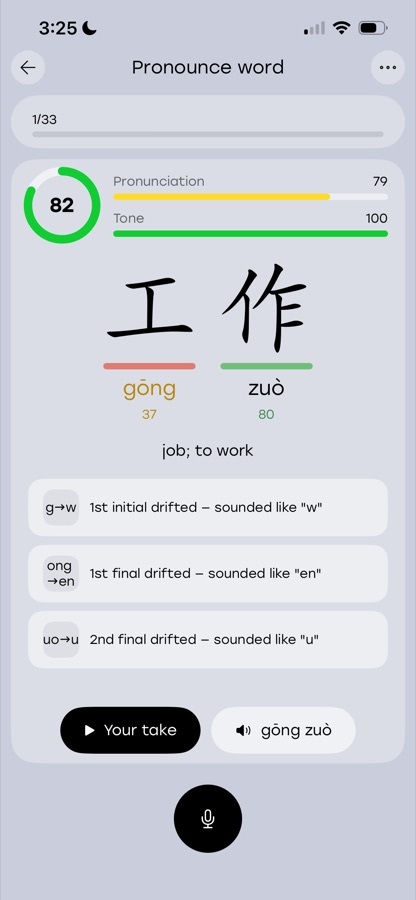
Tones. The pronunciation check works on any list. You say a word or phrase and get an overall score plus separate scores for the sounds and for the tones, and every character gets its own score in colour. The mistake is named in words, for example that an initial drifted or a tone did not change before the next word. So mǎi (买, buy) said as mài (卖, sell) shows up in the tone score, not as a vague low mark.
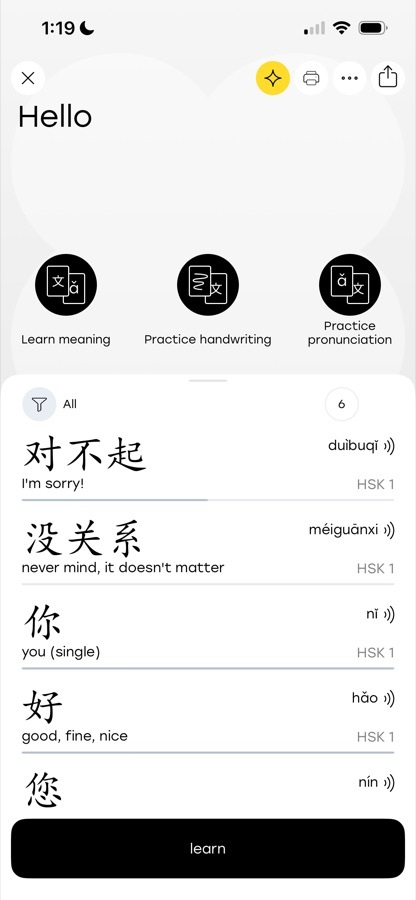
HSK and textbooks. You open the list for your level or this week's lesson and practise meaning, writing and pronunciation from the same screen.
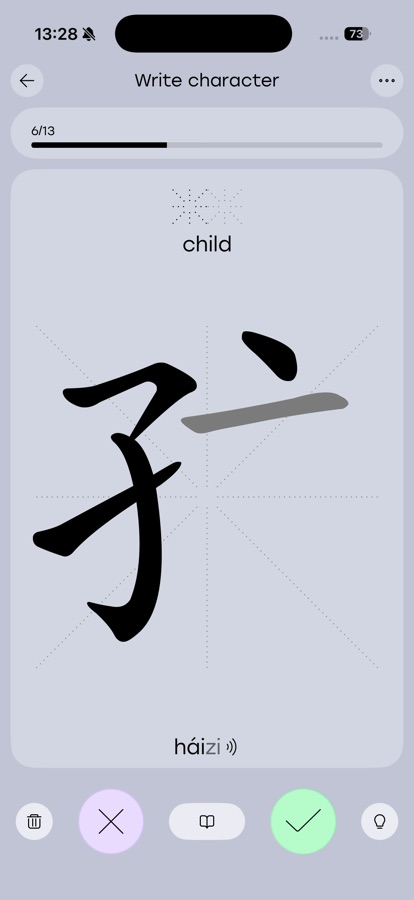
Characters. Writing practice gives stroke hints: one tap shows the next stroke, a double tap the whole character.
Limits: Laoshi does not draw a pitch graph, and the pronunciation check needs an internet connection. There is no Mac app; on a computer you use the free web Classroom, which has simpler flashcards. Apart from a 23-lesson beginner course on Chinese characters, Laoshi has no fixed course path: you choose the list. The download is free, and after the free trial Laoshi needs a subscription: App Store prices are $12.99 a month, $79.99 a year after a 7-day free trial, or $179.99 for lifetime access, and through Laoshi's web checkout it is $12.99 a month or $69.99 a year (US list prices, checked 7 November 2026). On the US App Store it has a 4.6 rating from 807 ratings (App Store).
Hack Chinese: HSK vocabulary in the browser
Hack Chinese is spaced repetition for recognising words. Its catalogue includes an HSK 3.0 (2026) list, with the 2021 framework labelled "Superseded", plus textbook lists (lists). Asked whether you will learn to write characters, its pricing page answers "No." There is no iOS or Android app yet; its pricing page says you can use it in a phone's web browser. It costs $18 a month, or $12 a month billed yearly, after a 21-day trial with no card. The first HSK 3.0 exam on the new lists is on 13 December 2026; our HSK 3.0 word lists article explains which list is which.
Du Chinese: graded reading
Du Chinese gives graded reading and listening lessons with audio and tap-to-look-up. Its pricing page says "a variety of lessons are available for free"; Premium unlocks all lessons for $14.99 a month, $79.99 for six months or $119.99 a year.
Pleco: the dictionary next to any course
Pleco is a Chinese dictionary app with two free dictionaries, CC-CEDICT and Pleco's own PLC with over 25,000 example sentences (App Store). Its paid Flashcard System ($9.99, or in the $29.99 Basic Bundle) adds spaced repetition, handwriting fill-in-the-blank and a Tone Practice test, and version 3.2.82 "added vocabulary for the refreshed 2026 HSK 3.0 test" to its premade cards.
Anki: free, if you build it yourself
Anki is free on Windows, macOS, Linux and Android, with free AnkiWeb sync; the iPhone app, AnkiMobile, is $24.99 once (App Store). You choose a shared deck or make one; for HSK 1, about 300 words is the new exam list, about 500 the 2021 standard.
Two set-ups after Duolingo
Keeping Duolingo, adding what it lacks. Duolingo for the daily lesson, plus a tool that hears your tones (Laoshi, or one from our tones guide) and one that teaches handwriting (Skritter or Laoshi).
Preparing for the HSK. A list made for the 2026 exam (Hack Chinese's "HSK 3.0 (2026)" list, Laoshi's lists from the official exam vocabulary, or Pleco's 2026 cards), Du Chinese for reading at your level, and the official sample papers in the last month.
Frequently Asked Questions
Is Duolingo good for learning Chinese?
It is a free, structured start: Mandarin with simplified characters and pinyin, with content through B2 on the CEFR scale since April 2026. It has speaking exercises, but its own pages do not describe handwriting practice for Chinese, feedback that names which tone you said wrong, or a mapping to HSK levels, so you may want a second app for those.
What is better than Duolingo for Mandarin?
It depends on what you miss. For another full course built for Chinese, HelloChinese or SuperChinese. For writing characters, Skritter. For tone feedback on your own word lists, plus writing and HSK lists, Laoshi. For HSK vocabulary, Hack Chinese. For reading, Du Chinese.
Does Duolingo teach Chinese characters?
Yes: simplified characters with pinyin, a character practice tab, and since October 2026 Component Sessions on the parts inside characters. Duolingo's own pages describe tracing for Japanese; the ones we read do not describe handwriting practice for Chinese.
Is Duolingo enough for the HSK?
Duolingo's current posts describe levels in CEFR and Duolingo Score, and its own pages that we read do not map the course to HSK levels or lists. For the HSK 3.0 exam starting 13 December 2026, study from a list built on the official exam vocabulary and practise with the official sample papers.
Does Duolingo correct Chinese tones?
Duolingo's Chinese course has speaking exercises, graded on whether your answer sounds close enough, and its tone guide describes listening practice; Duolingo's own pages do not describe feedback that names which tone you said wrong. Laoshi gives separate tone and sound scores for each attempt, and our tones guide compares other tools.
Sources for every claim are linked in the text and listed below. Duolingo details come from Duolingo's own blog and App Store listing; app details from each app's own website, store listing or pricing page, read on 7 November 2026.
Laoshi, an app for learning Chinese: App Store and Google Play.