


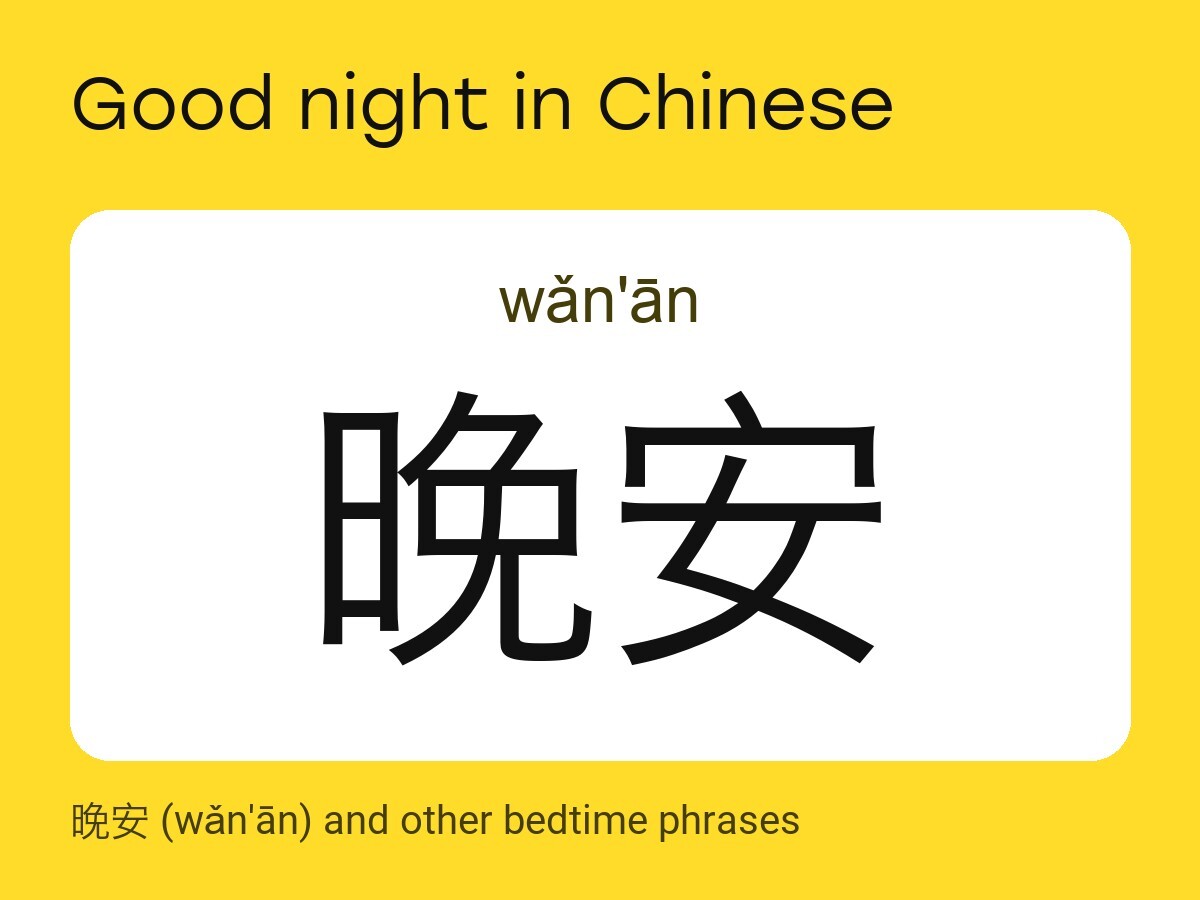
How to Say Good Night in Chinese: 晚安 (wǎn'ān) and Other Bedtime Phrases
By the Laoshi team. Laoshi is a Chinese-learning app, and it is ours.
Last updated: November 2026. Dictionary entries checked on 12 November 2026, HSK levels on 11 November 2026.
Short answer: good night in Chinese (Mandarin) is 晚安, pronounced wǎn'ān: third tone on wǎn, first tone on ān. It is written the same way in simplified and traditional characters. You say it when you leave someone in the evening or go to bed, and you can text it too. Don't confuse it with 晚上好 (wǎnshang hǎo), which means "good evening" and is said when you meet someone, not when you part.
晚安, character by character
晚安 is two characters, and each has its own page in our dictionary:
Put together, it reads roughly "a calm evening". Neither character has a separate traditional form, so 晚安 looks the same in mainland China, Taiwan and Hong Kong.
Tones. 晚 wǎn has the third tone, the low dipping one. 安 ān has the first tone: high and level. The apostrophe in wǎn'ān is a pinyin rule: it marks where a new syllable starts with a vowel, so you read wǎn-ān, not wǎ-nān.
How to write 晚安
Write 晚 first, then 安: 11 strokes and 6 strokes, 17 in all. Each frame below adds one stroke, shown in red.
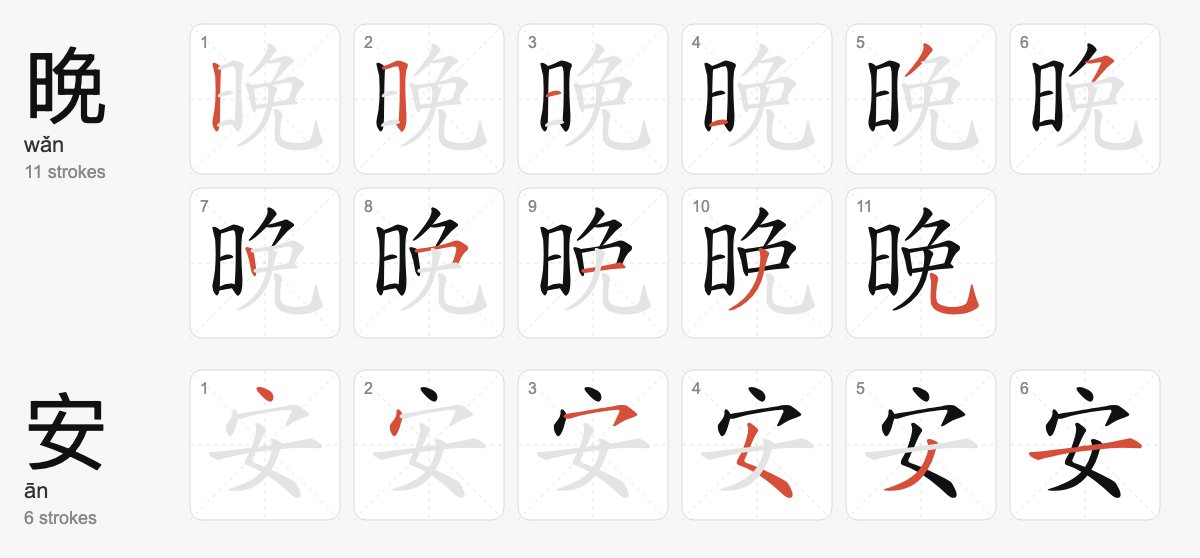
To watch the strokes animated, open our dictionary pages for 晚, 安 and the whole word 晚安 and press Animate. To type it, switch to any pinyin keyboard, type wanan and pick 晚安.
Other ways to say good night in Mandarin
晚安 is enough on its own. These phrases go with it or replace it:
| Chinese | Pinyin | Meaning | Word for word |
|---|---|---|---|
| 晚安 | wǎn'ān | Good night | evening + peaceful |
| 睡个好觉 (睡個好覺) | shuì ge hǎo jiào | Sleep well, have a good sleep | sleep + a + good + sleep |
| 好梦 (好夢) | hǎo mèng | Sweet dreams | good + dream |
| 做个好梦 (做個好夢) | zuò ge hǎo mèng | Have a good dream | make + a + good + dream |
| 祝你好梦 (祝你好夢) | zhù nǐ hǎo mèng | Wishing you sweet dreams | wish + you + good + dream |
| 早点睡 (早點睡) | zǎodiǎn shuì | Go to bed early | earlier + sleep |
| 早点休息 (早點休息) | zǎodiǎn xiūxi | Get some rest, go to bed early | earlier + rest |
| 明天见 (明天見) | míngtiān jiàn | See you tomorrow | tomorrow + see |
| 我去睡了 | wǒ qù shuì le | I'm off to bed | I + go + sleep + (now) |
Traditional characters are in brackets where they differ.
睡个好觉 comes from 睡觉 shuìjiào, "to sleep". It is a verb plus object, so it can be split, and 个 and 好 ("good") go in the middle. Our dictionary page for 晚安 has it as an example: 晚安,睡个好觉 ("goodnight, sleep tight!"). Note that 觉 is read jiào here, "a sleep", not jué. 个 is often said in a light, neutral tone, ge.
好梦, 做个好梦, 祝你好梦. 好梦 is literally "good dream". 做个好梦 uses 做梦 zuòmèng, "to have a dream", split the same way as 睡个好觉. 祝你好梦 starts with 祝 zhù, "to wish, to congratulate", the same word as in birthday wishes.
早点睡, 早点休息. 早点 zǎodiǎn here means "earlier, sooner", so 早点休息 means "go to bed early". The same two characters read as one noun mean "light breakfast", which is the meaning on our dictionary page for 早点, so context matters. 休息 xiūxi is "to have a rest".
明天见 is "see you tomorrow"; see 明天见 in our dictionary.
我去睡了 is built word by word: 我 "I", 去 "go", 睡 "sleep", and 了 at the end marks the change, so "I'm going to sleep now".
晚上好 means good evening, not good night
English keeps "good evening" and "good night" apart, and so does Mandarin. Dictionary usage notes say that in mainland China 晚上好 is used as a greeting, while 晚安 is used when parting or ending a conversation.
- 晚上好 wǎnshang hǎo: you arrive at a dinner, start an evening class or begin a broadcast. Literally "evening good". Dictionaries also write it wǎnshàng hǎo.
- 晚安 wǎn'ān: you leave, hang up or go to bed.
Taiwan differs. According to the same notes, 晚安 there is mostly a goodbye and seldom a greeting, and 晚上好 is not generally used in Taiwanese Mandarin. Some dictionaries give 晚安 both senses, "Good night! / Good evening!", while our dictionary gives only "good night". But if you learn mainland Mandarin, keep 晚上好 for hello and 晚安 for goodbye.
Good night in texts
晚安 works as a message on its own, and so do the phrases above, for example 晚安,好梦 ("good night, sweet dreams").
You may also see 88 in Chinese chats. It is internet slang for "bye-bye", from 拜拜 bàibài, not specifically "good night". Dictionaries also list a very different, hateful meaning of 88 in English, so keep it inside Chinese-language chats.
Good night in Cantonese: 早唞
Everything above is Mandarin. In Cantonese, you can say good night with 早唞, Jyutping zou2 tau2, literally "rest early". Dictionaries list it under the form 早敨, with 早唞 and 早抖 as other spellings, and give two senses for the interjection: "good night", and, said rudely, "shut up" or "go away". So the tone of voice matters. 晚安 also has a Cantonese reading, maan5 on1.
Three short dialogues
Ending an evening chat with a friend
- A: 我有点累,我去睡了。 Wǒ yǒudiǎn lèi, wǒ qù shuì le. I'm a bit tired, I'm off to bed.
- B: 好,晚安!早点休息。 Hǎo, wǎn'ān! Zǎodiǎn xiūxi. OK, good night! Get some rest.
- A: 晚安,明天见! Wǎn'ān, míngtiān jiàn! Good night, see you tomorrow!
A parent and a child at bedtime
- Parent: 十点了,该睡觉了。 Shí diǎn le, gāi shuìjiào le. It's ten o'clock, time for bed.
- Child: 好。妈妈晚安! Hǎo. Māma wǎn'ān! OK. Good night, Mom!
- Parent: 晚安,做个好梦。 Wǎn'ān, zuò ge hǎo mèng. Good night, sweet dreams.
Arriving and leaving: 晚上好, then 晚安
- On arrival: 晚上好! Wǎnshang hǎo! Good evening!
- Leaving: 我先走了,晚安! Wǒ xiān zǒu le, wǎn'ān! I'm heading off, good night!
- Host: 晚安,路上小心。 Wǎn'ān, lùshang xiǎoxīn. Good night, take care on the way home.
Which of these words are on the HSK 3.0 exam list
We checked each word against the official HSK 3.0 exam word list, the November 2025 syllabus tested from 13 December 2026, which you can search by level on chinesetest.cn. Our copy of the list was downloaded from that site on 8 November 2026.
- HSK 1: 晚 wǎn, 晚上 wǎnshang (evening), 睡 shuì, 睡觉 shuìjiào, 休息 xiūxi, 明天 míngtiān (tomorrow), 见 jiàn (to see), 早 zǎo (early), 好 hǎo (good)
- HSK 4: 晚安 wǎn'ān, 梦 mèng (dream), 做梦 zuòmèng, 祝 zhù
- HSK 5: 安 ān as a word on its own
晚上好, 明天见, 好梦, 早点 and 睡个好觉 are not separate entries on the exam list; each is built from words that are on it. So a beginner can already say 早点休息 or 明天见 with HSK 1 words, while 晚安 itself comes up as an HSK 4 word.
Lists disagree on the level of 晚安. Our own dictionary page marks it New HSK 2, and it sits on our New HSK 2 word list, but the list the HSK 3.0 exams test puts it at HSK 4. Our dictionary's HSK vocabulary lists follow the levels of the 2021 standard, not the exam list. If you are preparing for the exam, go by the exam list. More on why lists labelled "HSK 3.0" differ: HSK 3.0 word lists: what changed.
Where Laoshi fits
We make Laoshi, so read this part as what it is.
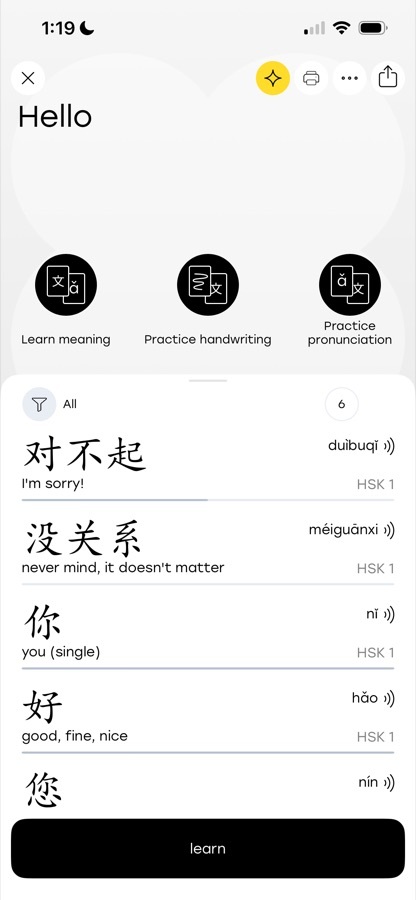
Each word linked above opens a free page in our online dictionary with pinyin, meaning, animated stroke order and example sentences, and you can add the word to a word list from there. 晚安 is a good one to start with.
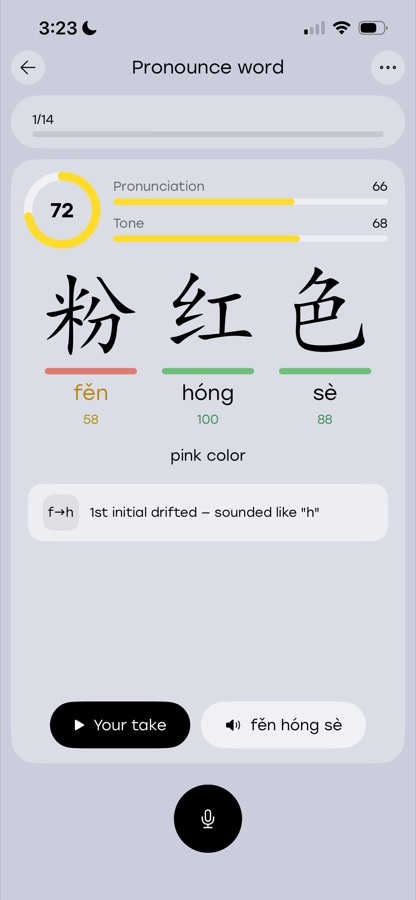
In the app, a two-syllable word like 晚安 is where tones go wrong: a third tone that never dips, a first tone that drops. Laoshi's pronunciation check gives two separate scores, one for sounds and one for tones, and names the slip in words. It works on any word list, including one you make yourself, so you can put tonight's phrases in a list and say them out loud. Laoshi does not draw a pitch graph, the check needs an internet connection, and Laoshi is a subscription app.
If you want to compare tools for tone practice, ours included, see apps to practise Mandarin tones.
Frequently Asked Questions
How do you say good night in Chinese?
晚安, pronounced wǎn'ān, with the third tone on wǎn and the first tone on ān. It is the standard good night in Mandarin, used when parting in the evening, going to bed or ending a chat.
What is the difference between 晚安 and 晚上好?
晚上好 (wǎnshang hǎo) means good evening and is a greeting when you meet someone. 晚安 (wǎn'ān) means good night and is said when you part or go to bed. In Taiwan, 晚上好 is not generally used.
How do you write good night in traditional Chinese?
The same way: 晚安. Neither character has a separate traditional form. Phrases with other characters do change, for example 好梦 becomes 好夢 and 睡个好觉 becomes 睡個好覺.
How do you say sweet dreams in Chinese?
好梦 (hǎo mèng), literally "good dream", or 做个好梦 (zuò ge hǎo mèng), "have a good dream". 祝你好梦 (zhù nǐ hǎo mèng) means "wishing you sweet dreams". All three are often said right after 晚安.
How do you say good night in Cantonese?
早唞, Jyutping zou2 tau2, literally "rest early". Said rudely it can also mean "shut up" or "go away", so the tone of voice matters. 晚安 also has a Cantonese reading, maan5 on1.
Meanings, pinyin, stroke order and example phrases come from our dictionary pages, linked in the text. Usage notes, the Taiwan and Cantonese forms, the reading of 觉 in 睡个好觉, the slang 88 and the second sense some dictionaries give 晚安 come from Wiktionary and MDBG (CC-CEDICT), read on 11 November 2026. HSK levels come from the official HSK 3.0 exam word list on chinesetest.cn, downloaded by Laoshi on 8 November 2026.
Laoshi, an app for learning Chinese: App Store and Google Play.