


HelloChinese vs SuperChinese vs Laoshi: Which Chinese App Fits You in 2026
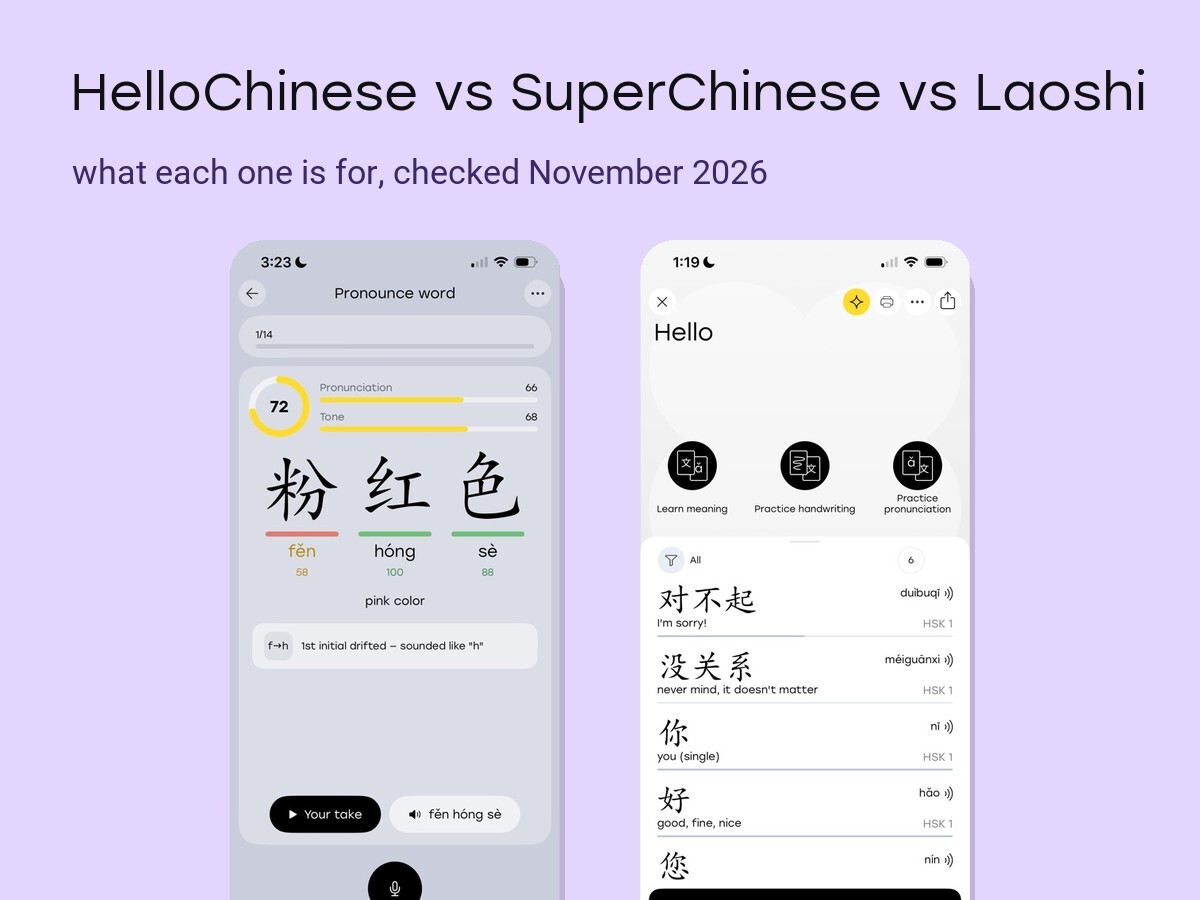
By the Laoshi team. Laoshi is our app, and it is one of the three compared here.
Last updated: November 2026. Pages, prices and features checked on 8 November 2026.
HelloChinese and SuperChinese are often compared with each other: both are complete beginner courses built only for Chinese. Laoshi is a different kind of app. It starts with a short beginner course on Chinese characters, and after that it is built around the word list you are studying, from your textbook or the HSK exam, with pronunciation and handwriting practice on every word. So the real question is less "which one is best" than "do you want a full course to lead you, or your own list to study".
Short answer:
- A game-like first course with lots to read: HelloChinese
- A course with an AI tutor and, on its pricier plan, conversation role-plays: SuperChinese
- Your textbook or HSK list, with feedback that scores your sounds and your tones separately, plus handwriting: Laoshi
- A course plus your own list: HelloChinese or SuperChinese for lessons, Laoshi next to it
How we checked
On 8 November 2026 we read each app's US App Store listing, including its in-app purchase list and release notes, and each official website. We did not test teaching quality and have not scored the apps. Where a page does not say something, we say so rather than guess. Prices are US list prices on that date and differ by country.
Most "HelloChinese vs SuperChinese" pages, such as languavibe's and SayMei's HelloChinese review, leave Laoshi out; SayMei also sells its own Chinese-learning product. This page is written by the Laoshi team, and Laoshi's section says what it does not do.
Side-by-side
| HelloChinese | SuperChinese | Laoshi | |
|---|---|---|---|
| Course structure | Game-like beginner course: pinyin course, then Main Course 2.0 with "430+ grammar and 2,500+ words"; 1,000+ graded stories, 2,000+ videos | App Store: 400+ lessons, 9 levels, 50+ themes. Website: 8-level path, 1,000+ lessons of about 10 minutes | Beginner course "Chinese characters basics" (23 lessons: tones, how characters work, first strokes and characters); after it, no fixed path: you pick a word list (HSK, textbook, topic or your own); 756 grammar points with explanations |
| Levels / HSK | "Systematic courses based on HSK levels"; HSK version not stated | App Store: 9 levels, basic to advanced. Website: 8 levels, "Beginner to HSK 5", content "equivalent to HSK 1–5"; HSK version not stated | HSK 2.0 and HSK 3.0 lists from the official exam vocabulary, including the 7–9 band; 71 textbook series |
| Speaking feedback | "Speech recognition corrects your pronunciation"; per-tone detail not stated | Speech recognition; "your AI language tutor lets you know where you need to improve"; CHAO plan adds role-plays | Overall score plus separate sound and tone scores per attempt, a coloured score per character, the mistake named in words |
| Characters / writing | Handwriting practice; simplified and traditional characters | "Write Characters" in lessons | Writing on any list, with stroke hints; printable handwriting worksheets |
| App interface languages (App Store) | 13, English included | 16, including Simplified and Traditional Chinese | 10, English included |
| Price (US) | Free download; Premium $11.99/mo, $25.99/3 mo, $69.99/yr; Premium+ listed from $19.99 | PLUS $11.99/mo, $59.99/yr, $139.99 lifetime; CHAO $24.99/mo, $109.99/yr | App Store: $12.99/mo, $79.99/yr after a 7-day free trial, $179.99 lifetime; $12.99/mo or $69.99/yr through Laoshi's web checkout |
| Platforms | iOS, Android; the App Store also lists Apple-silicon Macs | iOS, Android; the App Store also lists Apple-silicon Macs | iOS, Android; free web Classroom |
| US App Store rating | 4.9 from 23,898 ratings | 4.9 from 3,897 ratings | 4.6 from 807 ratings |
HelloChinese: a game-like course with a lot to read
HelloChinese is a game-like course for beginners. Its App Store listing names a pinyin course for newcomers, speech recognition that "corrects your pronunciation", handwriting "to learn Chinese characters", 1,000+ graded stories, over 2,000 videos with native speakers, and both simplified and traditional characters (App Store). Downloaded courses work offline.
The course has grown recently. Release notes from August 2026 say "Main Course 2.0 just got bigger with new upper-intermediate sections" and now covers "430+ grammar and 2,500+ words". The listing says its courses are "based on HSK levels" but does not name a version. In a 2024 reply to a review, the developer said the Stories follow the newest HSK guidelines while the main course followed an older version, with a new course in development. We found no statement from HelloChinese on whether anything in the app follows the November 2025 exam syllabus that the 13 December 2026 exam tests.
What the pages don't say: whether tones are scored apart from sounds, and which lessons stay free without Premium. Premium is $11.99 a month, $25.99 for three months or $69.99 a year. Premium+ is listed from $19.99, without a description of what it adds.
SuperChinese: a course with an AI tutor
SuperChinese is a full course too, and it counts its levels differently depending on where you look:
- App Store: "over 400 Lessons, split into 9 Chinese levels and based on more than 50 interesting themes", from "basic Chinese to advanced Chinese" (App Store).
- Website: 8 levels, "Beginner to HSK 5", 1,000+ lessons of about 10 minutes, 200+ topics, and content "equivalent to HSK 1–5" (website).
Neither page says which HSK version the levels follow. Like HelloChinese, it covers pinyin for beginners, and a free level test in the app places you at a starting level.
For speaking, the listing names speech recognition, help to "pronounce words in the right tone", and an AI tutor that "lets you know where you need to improve"; it does not say whether tone is scored on its own. The website says every lesson "is written by native Chinese teachers", and that AI is used for "explaining mistakes, refining your sentences, and giving you someone to practice speaking with". The CHAO plan "gives you more opportunities to practice real-world conversations through role-plays and everyday scenarios". Lessons also include writing characters and spaced repetition.
US in-app prices: PLUS at $11.99 a month, $59.99 a year or $139.99 for life, and CHAO at $24.99 a month or $109.99 a year; other yearly PLUS prices are also listed.
Laoshi: the word list you study, with sounds and tones scored apart
Laoshi is our app, so weigh this section with that in mind.
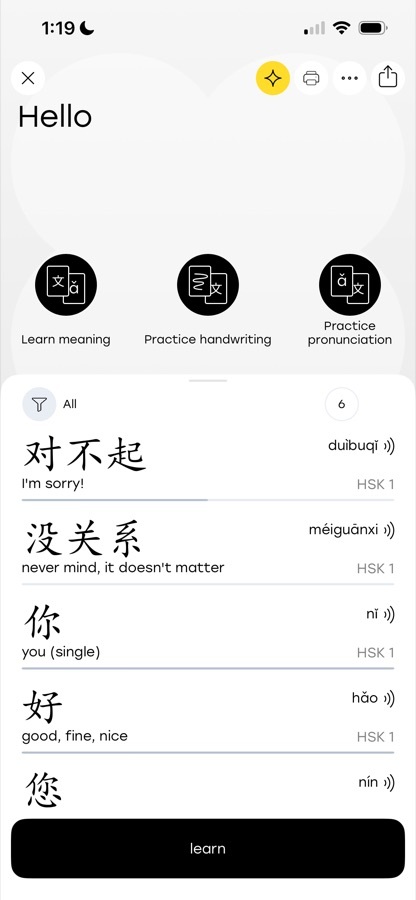
Laoshi is an app for learning Chinese built around word lists. A complete beginner starts with "Chinese characters basics", a practical course of 23 short lessons: how characters appeared and how they are built, what tones are, how Chinese differs from other East Asian languages, and writing the basic strokes and your first characters right on the phone screen. It is included in the same subscription. After that you open the list for your HSK level (HSK 3.0 lists follow the official exam vocabulary from chinesetest.cn, including the 7–9 band, with HSK 2.0 lists alongside), this week's lesson from your textbook (a library of 71 series split into 4,474 lesson lists), a topic list, or a list you make yourself or paste in from Anki, Quizlet or Pleco through Laoshi Classroom, our web app. Reviews run on spaced repetition, and a grammar section has 756 points with explanations.
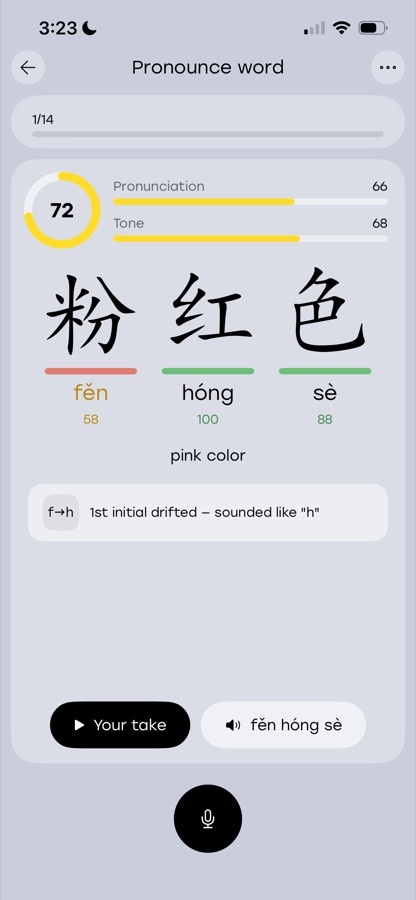
Pronunciation. The check works on any list. You say a word or a whole phrase and get an overall score plus separate scores for the sounds and for the tones, and each character gets its own score in colour. The mistake is named in words, for example a dropped syllable or a tone change before the next word. So mǎi (买, buy) said as mài (卖, sell) shows up in the tone score, not as a vague low mark. You can play the reference and then your own take.
Characters. Writing practice works on every list. One tap shows the next stroke, a double tap the whole character, and any list prints as a handwriting worksheet.
What Laoshi does not do: beyond the beginner course there is no path that leads you through grammar and dialogues lesson by lesson, and sentence-building exercises live in the web Classroom rather than the app, so a learner who wants a full course to lead them up to conversation is better served by HelloChinese or SuperChinese. The pronunciation check needs an internet connection, and it does not draw a pitch graph. There is no Mac app; on a computer you use the free web Classroom. The download is free. In the US, the App Store price is $12.99 a month, $79.99 a year after a 7-day free trial, or $179.99 for lifetime access, and Laoshi's web checkout charges $12.99 a month or $69.99 a year; prices in other countries differ. Its US App Store rating, 4.6 from 807 ratings, is lower than both courses' and comes from far fewer ratings.
Which to pick
Pick HelloChinese if you are starting from zero, want short game-like lessons that begin with pinyin, and enjoy reading: it lists 1,000+ graded stories and over 2,000 videos. It also supports traditional characters, if you need them.
Pick SuperChinese if you want a structured course with an AI tutor that explains mistakes, and you would pay more (CHAO, $109.99 a year) for role-play conversation practice. Take the free level test first.
Pick Laoshi if you already have a textbook, a class or an HSK date, and want to study exactly those words, with a score that tells your tone mistakes apart from your sound mistakes and handwriting on the same list. A complete beginner can start with its characters course; for a full course of grammar and dialogues, put it next to HelloChinese or SuperChinese.
Combine them if you want both: a course for lessons and conversation, plus Laoshi for the words your exam or class expects. The first official worldwide HSK 3.0 sitting is on 13 December 2026; our HSK 3.0 word lists article explains which list is which.
Frequently Asked Questions
Is HelloChinese or SuperChinese better?
Neither is better for everyone. Both are full beginner courses with speech recognition and handwriting, at the same $11.99 monthly price. Both start beginners with pinyin. HelloChinese adds 1,000+ graded stories and supports traditional characters. SuperChinese leans on an AI tutor, and its CHAO plan adds role-play conversations. Neither app's pages say whether tones are scored separately from sounds or which HSK version they follow.
Is SuperChinese worth it?
It is worth it if you want a structured course and will use the AI feedback: PLUS costs $59.99 a year or $139.99 for life, and CHAO, with role-play conversations, $109.99 a year. Its website puts the top level at about HSK 5. Take the free level test before paying; if you mainly need HSK vocabulary or tone feedback on your own words, a more focused app may fit better.
Can I use HelloChinese and Laoshi together?
Yes, they do different jobs. HelloChinese gives you lessons, stories and videos; Laoshi gives you your textbook or HSK list, pronunciation feedback with separate sound and tone scores, and handwriting on those words. The same works with SuperChinese.
Is HelloChinese free?
It is free to download, with Premium at $11.99 a month or $69.99 a year. Its listing does not say which lessons stay free without Premium.
Which of the three is best for HSK 3.0?
Laoshi's HSK 3.0 lists follow the official exam vocabulary, including the 7–9 band. HelloChinese says its courses are based on HSK levels and SuperChinese says its content is equivalent to HSK 1–5, but neither names the HSK version. For the first official HSK 3.0 sitting on 13 December 2026, study the official list and practise with the official sample papers.
Sources for every claim are linked in the text and listed below. HelloChinese and SuperChinese details come from each app's own App Store listing and website, read on 8 November 2026.
Laoshi, an app for learning Chinese: App Store and Google Play.